
· Rumtoo Engineering Team · Buying Guides · 8 min read
Water Ring Plastic Pelletizers: Complete Buyer's Guide for PE, PP Film and Raffia Recycling
A practical buyer's guide to water ring plastic pelletizers for PE film, PP raffia, woven bags, and soft plastic recycling. Learn where water ring systems outperform strand lines, where they do not, and how to size the right configuration.
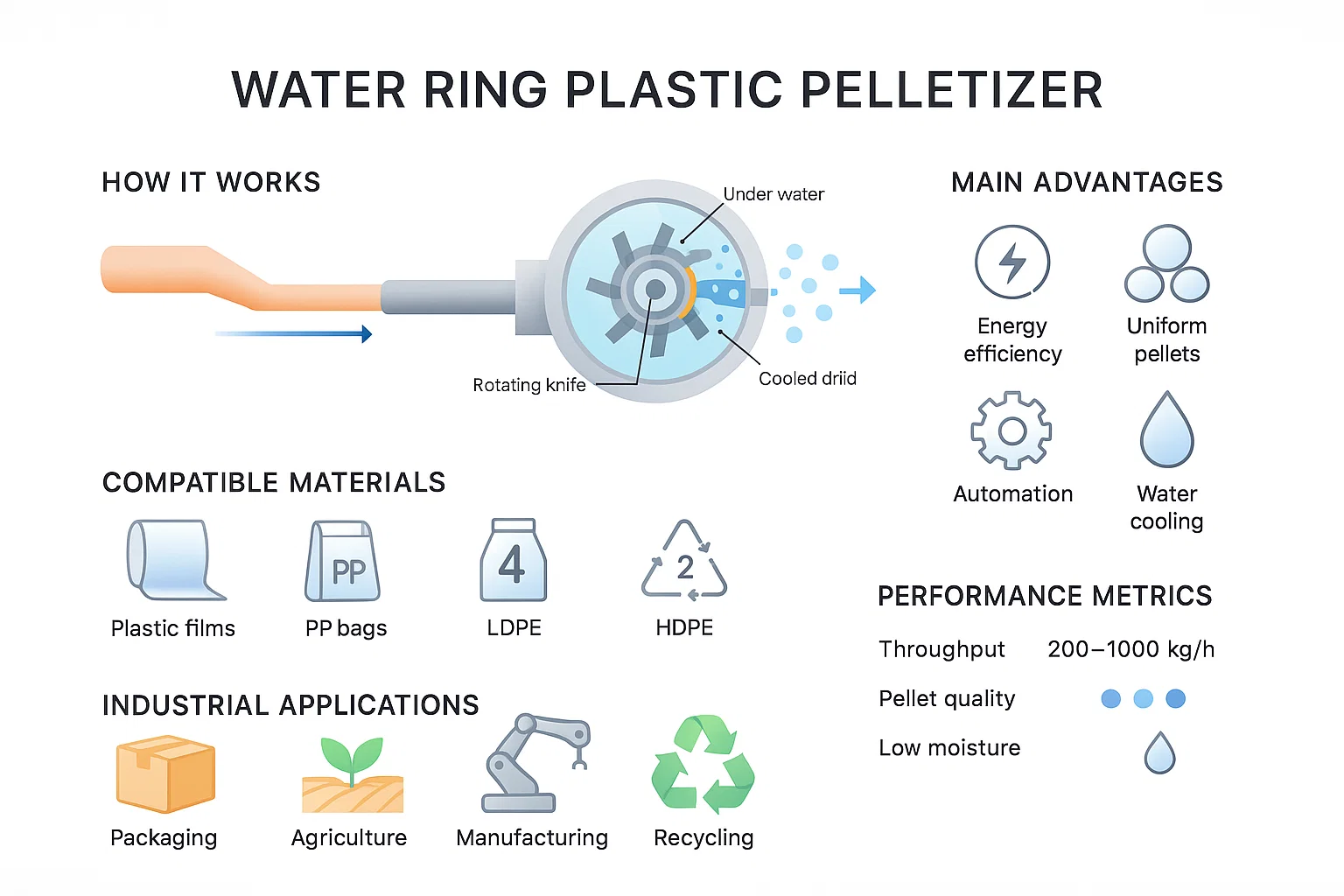
A water ring plastic pelletizer (hot die-face cutting with circular water-jacket quenching) is the industry standard for recycling low-melt-strength flexible polymers, including polyethylene (LDPE, LLDPE, HDPE) films, polypropylene (PP) woven bags, raffia, and post-consumer flexible packaging. In flexible recycling lines, conventional strand pelletizing frequently collapses: soft strands stretch, sag in cooling troughs, snap during melt surges, and wrap around granulator rollers, creating endless downtime and mountain of startup purge scrap.
Water ring technology solves this operational bottleneck by cutting molten polymer immediately as it emerges from the die plate, instantly capturing each pellet in a high-speed centrifugal water curtain without unsupported strand travel.
When configuring a complete plant, Rumtoo pairs water ring pelletizing with our turnkey recycling pelletizing lines and specialized film compacting pelletizing line. For an in-depth financial evaluation, review our detailed guide on plastic pelletizer price: water ring vs. strand systems and explore equipment layout differences in our vertical vs. horizontal water ring pelletizer comparison.
The Complete Water Ring Pelletizing Operating Cycle
A modern closed-loop water ring system operates through five tightly synchronized mechanical stages:
- Precision Extrusion Die Plate: Molten, filtered plastic enters a circular heated die plate featuring a radial pattern of hardened orifice holes (typically Ø 2.0 mm to 3.2 mm). The die plate is maintained at precise processing temperatures (190°C–230°C for polyolefins) via high-density ceramic or cast bronze heating bands.
- Die-Face Rotary Slicing: A multi-blade cutter hub (equipped with 2 to 12 tool-steel or carbide blades) rotates flush against the die plate at 1,000 to 2,800 RPM. As polymer emerges, the high-speed blade slices it into cylindrical, lens-shaped, or spherical micro-droplets.
- Centrifugal Water Curtain Quenching: Water is pumped tangentially into the cutting chamber, forming a high-velocity vortex ring against the chamber’s outer circumference. Centrifugal force flings freshly cut hot pellets away from the die face into the swirling water curtain. The water instantly chills the outer shell of the pellet, preventing sticking or agglomeration. Crucially, the water does not touch the die plate face directly, preventing thermal shock or die-hole freezing.
- Hydraulic Slurry Transport: The water-pellet slurry flushes continuously out of the chamber discharge chute into an inclined stainless steel dewatering sieve.
- Centrifugal Spin Drying & Classification: A high-speed vertical centrifugal dryer (1,200–1,500 RPM) spins residual moisture off the pellets, discharging clean, dry pellets (< 0.5% surface moisture) over a vibrating grading sieve into storage silos or bagging stations. Cooling water drains into a recirculating reservoir equipped with plate heat exchangers and bag filters.
Technical Specifications: Rumtoo Industrial Water Ring Series
Rumtoo manufactures high-efficiency horizontal and vertical water ring pelletizing systems tailored to recycling capacities:
| Parameter | WR-350 System | WR-500 System | WR-800 System | WR-1200 System |
|---|---|---|---|---|
| Nominal Throughput Range | 250 – 450 kg/h | 500 – 750 kg/h | 800 – 1,100 kg/h | 1,200 – 1,800 kg/h |
| Die Plate Orifice Count | 48 – 72 holes | 80 – 120 holes | 140 – 200 holes | 220 – 320 holes |
| Standard Orifice Diameter | Ø 2.4 mm – 2.8 mm | Ø 2.6 mm – 3.0 mm | Ø 2.8 mm – 3.2 mm | Ø 2.8 mm – 3.5 mm |
| Cutter Drive Motor | 2.2 kW (Inverter VFD) | 4.0 kW (Inverter VFD) | 5.5 kW (Inverter VFD) | 7.5 kW (Inverter VFD) |
| Cutter Speed Range | 800 – 2,400 RPM | 800 – 2,600 RPM | 600 – 2,200 RPM | 600 – 2,000 RPM |
| Cutter Blade Count | 4 to 6 blades | 6 to 8 blades | 8 to 10 blades | 10 to 12 blades |
| Water Pump Capacity | 7.5 kW (25 m³/h) | 11.0 kW (40 m³/h) | 15.0 kW (60 m³/h) | 22.0 kW (90 m³/h) |
| Dewatering Centrifuge Motor | 4.0 kW (Vertical Spin) | 5.5 kW (Vertical Spin) | 7.5 kW (Vertical Spin) | 11.0 kW (Vertical Spin) |
| Final Pellet Surface Moisture | < 0.5% wt | < 0.4% wt | < 0.3% wt | < 0.3% wt |
| Die Metallurgy | Bimetallic Tungsten Alloy | Bimetallic Tungsten Carbide | HIP Laser Clad Carbide | Solid Tungsten Carbide Ring |
Water Ring vs. Alternative Pelletizing Technologies
Choosing between water ring, strand, and full underwater systems involves trade-offs across capital cost, operator workload, and polymer rheology:
| Feature | Water Ring Pelletizer | Cold Strand Pelletizer | Full Underwater Pelletizer |
|---|---|---|---|
| Optimal Materials | PE film, PP film, woven bags, agricultural film | Rigid HDPE, PP crates, ABS, PS, PC, PET | TPU, EVA, hot-melts, extreme MFI resins (>30) |
| Capital Cost (CAPEX) | Moderate ($38k – $98k) | Low ($28k – $75k) | High ($180k – $350k+) |
| Operator Skill Requirement | Low; push-button start | High; manual strand feeding & tensioning | Low-to-moderate; complex water controls |
| Strand Break Downtime Risk | Zero (no strands) | Very High on soft film melts | Zero (no strands) |
| Footprint Requirements | 4 – 6 meters linear floor space | 12 – 18 meters linear floor space | 5 – 7 meters compact footprint |
| Pellet Geometry | Lens, button, or mini-pillow | Regular solid cylinder | Perfectly spherical micro-pellets |
| Die Maintenance Ease | Excellent; swing-open trolley mount | Good; accessible flat die plate | Complex; specialized knife alignment tools |
4 Engineering Advantages of Water Ring Pelletizing
1. Superior Handling of Melt Swell and Low Melt Strength
Recycled LDPE and LLDPE film scrap exhibit erratic melt elasticity and high elongation. When extruded as free strands into a water bath, localized hot spots cause necking, sagging, and breaking. In a water ring cutter, the polymer is sliced before gravitational sag or draw-down can occur.
2. Radical Reduction in Factory Labor Overhead
A cold strand pelletizer requires an operator to constantly watch the water trough, re-thread broken strands, and clean wrapped granulator nip rolls. A water ring pelletizer runs fully automated inline; a single line operator can easily oversee two or three pelletizing lines simultaneously, saving tens of thousands in payroll annually.
3. Compact Plant Footprint
A typical 1,000 kg/h strand line requires an 8-to-12 meter cooling tank plus air blowers and granulator, taking up over 15 meters of linear plant space. A water ring pelletizer cuts, quenches, and dewaters within a tight 4-to-5 meter footprint, preserving valuable square footage for scrap storage and finished goods staging.
4. Uniform Bulk Density and Dust-Free Pellets
Strand pelletizers produce fine dust and “tails” when cutting blades become slightly dull. Water ring die-face cutting shears hot polymer cleanly, creating rounded, smooth-edged pellets with zero angel hair, dust, or fines.
Common Operational Challenges and Engineering Solutions
Even robust water ring systems can experience operational hiccups if process parameters drift. Here is how Rumtoo engineers troubleshoot common issues:
1. Pellet Twinning and Agglomeration (“Doubles / Chains”)
- Root Cause: Pellet surface cooling too slowly, or cutter speed too slow relative to extrusion flow rate.
- Solution: Increase water circulation flow rate; lower water inlet temperature to 35°C–45°C via plate heat exchanger; increase cutter VFD motor RPM.
2. Die Hole Freezing (Die Freeze-Off)
- Root Cause: Water splashing back onto the die face, or inadequate die zone heating.
- Solution: Ensure water ring chamber discharge chute is unrestricted; check die zone heater thermocouple calibration; verify tangential water injection angle to prevent turbulence toward the center die face.
3. Hollow Pellets or Internal Porosity
- Root Cause: Excessive moisture in the melt from upstream washing lines turning into steam bubbles.
- Solution: Improve upstream mechanical dewatering using a film densifier and squeezer or inspect extruder vacuum degassing ports. Refer to our checklist for pelletizer maintenance.
4. Blade and Die Face Scuffing
- Root Cause: Excessive mechanical blade preload pressure or inadequate lubrication.
- Solution: Calibrate pneumatic blade clamping pressure (0.2–0.4 bar is optimal); ensure cutter hub axial alignment is within 0.03 mm runout tolerance.
Feedstock Compatibility Guide
- Post-Consumer LDPE Agricultural Film: Ideal fit. Hot die-face cutting easily handles recycled LDPE containing traces of residual moisture or mineral fillers.
- PP Woven Bags / Raffia / FIBC Big Bags: Ideal fit. Eliminates strand embrittlement caused by high molecular orientation.
- Stretch Film (LLDPE): Ideal fit. Overcomes the extreme elasticity of stretch film that ruins strand pulling.
- Rigid HDPE Flakes (Bottles/Pails): Compatible with both water ring and strand pelletizers. Strand is often chosen if cylindrical pellet appearance is strictly mandated by the end buyer.
- PET Flakes: Unsuitable for standard water ring systems. PET requires precise underwater or specialized strand crystallization to prevent severe die freezing and brittle dust formation.
Essential Buyer Checklist for Water Ring RFQs
Before finalizing your equipment quotation, ensure your supplier explicitly guarantees:
- Die Plate Metallurgy: Demands bimetallic tungsten carbide facing with minimum 4.0 mm wear layer thickness (HRC >62).
- Pneumatic / Spring Blade Tracking: Automated cutter hub tracking that self-adjusts for blade wear without operator micrometer intervention.
- Stainless Steel Dewatering Centrifuge: Entire spin dryer housing, rotor paddles, and perforated screens must be AISI 304/316 stainless steel to eliminate rust contamination.
- Closed-Loop Water Management: Inclusion of a high-efficiency stainless steel plate heat exchanger, centrifugal cooling pump, and dual bag filtration skid.
Frequently Asked Questions
What water temperature should be maintained in the water ring?
Optimal process water temperature for polyolefins is 35°C to 50°C. Water below 25°C can cause thermal shock and die freeze-off, while water above 60°C fails to quench the pellet skin fast enough, resulting in agglomeration.
How often do cutter blades need replacement?
With bimetallic tungsten carbide die plates and high-speed tool steel blades, typical blade lifespan is 120 to 240 operating hours when processing clean film, or 80 to 120 hours on abrasive post-consumer agricultural film. Blades are double-edged and can be reversed in 15 minutes.
What is the maximum throughput for water ring pelletizing?
Standard single-die water ring pelletizers efficiently handle up to 1,800 to 2,000 kg/h. Above 2,000 kg/h, die plate diameter exceeds thermal balance limits, and underwater pelletizing or twin-head water ring designs are recommended.
Partner with Rumtoo for Superior Pellet Quality
A high-performance water ring pelletizer transforms volatile plastic scrap into high-value, dust-free recycled pellets with minimal operator intervention.
Contact the Rumtoo Engineering Team today for personalized process recommendations, sample trial runs, and complete turnkey plastic film and bag recovery lines.
- water ring plastic pelletizer
- water ring pelletizing
- PE film recycling
- PP raffia pelletizing
- recycling pelletizing line