

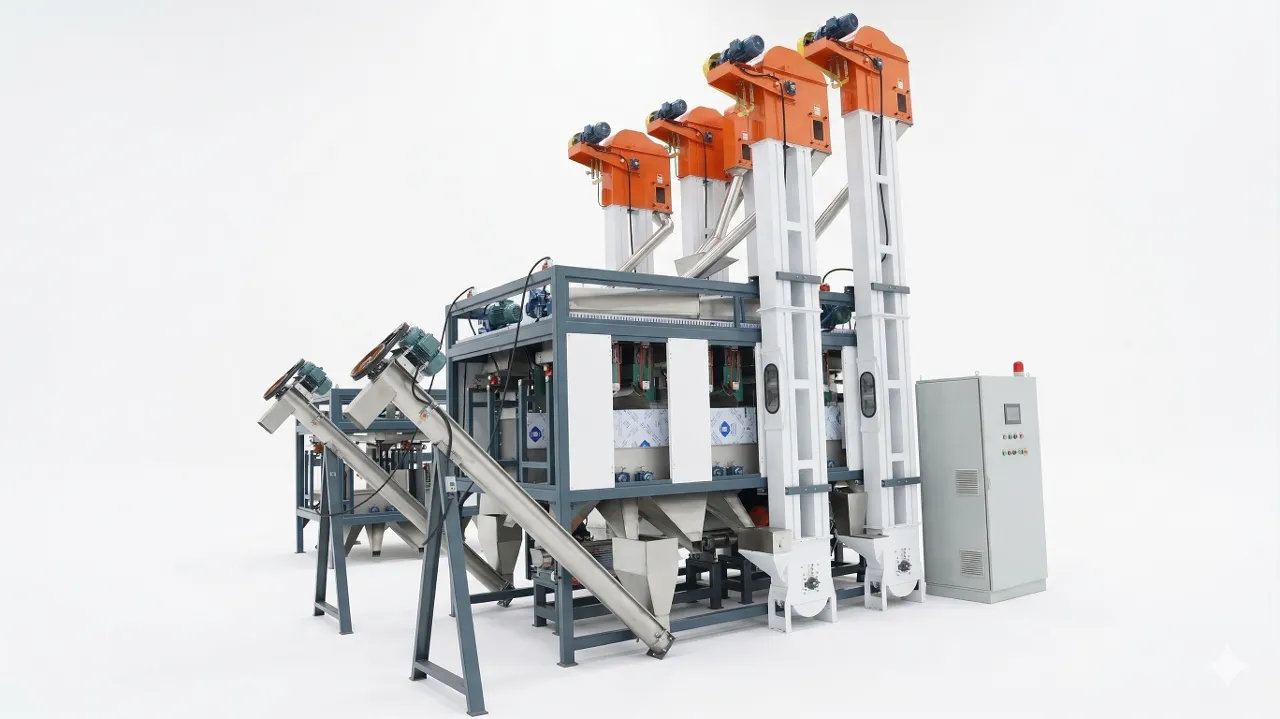
Ancillary Equipment

Electrostatic Separator

A dry purification system using high-voltage fields to split mixed plastics like PVC/PET, PE/PP, and ABS/PS with 99%+ purity.

  • Matched to your feedstock and output target
  • Stable throughput with controlled discharge size
  • Layout, controls, and service support customized
View Specifications
Scroll
Electrostatic Separator
  • Matched to your feedstock and output target
  • Stable throughput with controlled discharge size
  • Layout, controls, and service support customized

Backed by Documented Performance Targets

CE Certified Manufacturing
24/7 Global Technical Support
12-Month Comprehensive Warranty
Turnkey Installation & Training

How Electrostatic Separation Works

A practical four-step process focused on stable operation and consistent output.

1

Metered, Size-Classified Feed

Dry flake (2–10 mm, below 0.5% moisture) is metered onto the unit in a thin, even layer. Consistent size and dryness are what make a stable surface charge possible.

2

Triboelectric Charging

As the flake tumbles through the charging stage, the two polymers rub against each other and the chamber walls and pick up opposite surface charges — one positive, one negative.

3

High-Voltage Field Deflection

The charged flake then falls through a high-voltage electrode field. Positively and negatively charged particles bend toward opposite electrodes, splitting into separate trajectories.

4

Split & Collect

An adjustable splitter divides the streams into product, middling and reject bins. The middling fraction can be re-fed to push final purity higher.

Key Advantages

Dry, Chemical-Free

No water, detergents or heat — only electrostatic force. That means no wastewater to treat, no drying step afterward, and a low energy cost per ton.

Reach <50 ppm PVC-in-PET

High-voltage separation drives residual PVC in PET below 50 ppm, the threshold for food-grade rPET pricing. It removes the contaminant that washing and optical sorting leave behind.

Sorts Black & Dark Plastics

Separation is by surface charge, not color or NIR reflectance, so it handles dark and carbon-filled plastics that optical sorters cannot see at all.

Splits Density-Overlapping Pairs

ABS/PS and PE/PP have densities too close for a sink-float tank, but they charge differently and separate cleanly here — the polishing step a density line cannot do.

Problem-Solution Fit

Problem

Unstable feedstock conditions reduce production consistency.

Rumtoo Solution

Engineering configuration is matched to material variability and throughput targets.

Problem

Inconsistent quality creates downstream process risk.

Rumtoo Solution

Process design focuses on output stability for downstream stages.

Problem

Frequent intervention increases labor and maintenance pressure.

Rumtoo Solution

Service-friendly structure supports efficient operation and maintenance.

Problem

Scaling capacity can disrupt existing line performance.

Rumtoo Solution

Modular integration supports phased expansion and retrofit planning.

Where the Electrostatic Separator Sits in a Recycling Line

Electrostatic separation is a dry polishing stage. It belongs after washing and drying, on size-classified flake, once density sorting has split the bulk resin types — it makes the final single-resin cut that density and optical sorting cannot.

Electrostatic separator triboelectric charging and electrode stage

Equipment View: Triboelectric Charging + High-Voltage Field

Dry flake is tribo-charged as it tumbles — different polymers pick up opposite surface charges — then fed into a high-voltage electrode field where oppositely charged particles deflect to separate collection bins. No water, no heat, no chemicals.

  • Tribo-charging stage tuned to the specific polymer pair
  • High-voltage electrode field, stage count sized to resistivity
  • Adjustable splitter to balance purity against yield

Process View: After Density Sorting, Before Pelletizing

A typical line runs: shredder → wash → dry → sink-float density sort → electrostatic separator → pelletizer. The electrostatic stage takes a binary or near-binary fraction and lifts it to single-resin purity. Feed must be dry (<0.5% moisture) and size-classified.

  • Requires dry feed below 0.5% moisture
  • Works best on binary pairs, not complex mixes
  • Output feeds pelletizing or a final QC step
Electrostatic separator position in a plastic recycling line

Video Demonstration

View the machine workflow under real operating conditions.

Typical Use Cases

  • PVC-in-PET Purification

    Removes residual PVC from washed PET flakes for bottle-to-bottle extrusion.

  • PE/PP Fraction Separation

    Splits mixed rigid packaging where density differences are too small.

  • ABS/PS Separation

    Separates the near-overlapping ABS/PS pair from shredded appliance and WEEE plastics, where density sorting fails.

  • Black & Dark Plastics

    Sorts dark, carbon-filled plastics that NIR optical sorters cannot see, using surface charge instead of color.

  • E-Waste Metal/Plastic

    Recovers metal particles from cable jacket regrind in a dry process.

  • PE/PP Polishing After Density Sorting

    After a sink-float stage where PE and PP both float together, electrostatic separation splits the polyolefin fraction density alone cannot.

Technical Specifications

ParameterSpecificationNotes
ES-600300-600 kg/hPVC/PET, ABS/PS
ES-1000600-1000 kg/hPE/PP and mixed rigid flakes

Final purity depends on moisture, particle size, and material pair.

RFQ Checklist — What We Need to Size Your Separator

These inputs let us recommend the stage count, electrode configuration, and a realistic purity target.

  1. Material Pair

    Which two plastics to split (PVC/PET, PE/PP, ABS/PS) and which one is the contaminant to remove.

  2. Current & Target Purity

    Contaminant level in the feed now and the purity your buyer requires — e.g. PVC-in-PET below 50 ppm.

  3. Feed Condition

    Moisture (must be <0.5%) and flake size range (2–10 mm), plus whether washing and drying are already in place.

  4. Throughput & Hours

    Average and peak kg/h plus hours per day, to size between the ES-600 and ES-1000.

  5. Upstream Stages

    What precedes the separator — washing, drying, density sorting — since electrostatic is a polishing step, not a primary sort.

  6. A Representative Sample

    A few kilograms of real feed lets us test the achievable purity and quote against a measured result.

Why Choose Rumtoo

CriteriaConventional SetupRumtoo Solution
Process StabilityMore fluctuation under feed variationDesigned for stable operation across variable feedstock
Output ConsistencyHigher variation in downstream qualityProcess control focused on consistent output
IntegrationHigher retrofit complexityPractical integration with existing lines
Lifecycle SupportLimited startup optimization supportEngineering support from planning to commissioning

Frequently Asked Questions

What is an electrostatic separator?

A machine using high-voltage fields to split plastics based on the surface charge each polymer picks up when tribo-charged.

Does the feed need to be dry?

Yes, typically below 0.5% moisture. Surface moisture bleeds away the electrostatic charge and collapses the separation, so the material must be washed and dried first.

Can it separate ABS from PS?

Yes. ABS and PS have nearly identical densities so a sink-float tank cannot split them, but they charge oppositely and separate well electrostatically on dry, size-classified feed.

Can it sort black plastics?

Yes. Separation is by surface charge, not color or NIR reflectance, so it handles dark and carbon-filled plastics that optical sorters cannot see.

How does it work together with sink-float density sorting?

They are complementary. Density sorting splits the bulk resin types; the electrostatic stage then polishes a binary fraction to single-resin purity — for example separating PE from PP, which both float. Dry the material between the wet tank and the electrostatic stage.

What purity can it reach?

On dry, size-classified binary feed, 99%+ purity is achievable, and PVC-in-PET can reach below 50 ppm for food-grade rPET. Actual results depend on the polymer pair, moisture and particle size, so we test your material first.

Need an Electrostatic Separator Proposal?

Share your material type, expected throughput, and project location for a tailored proposal.

Expert response within 24 hours. No obligation quote.