
· Rumtoo Engineering Team · Buying Guides · 7 min read
Plastic Pelletizer Price: Water Ring vs. Strand Systems
Compare plastic pelletizer price for water ring and strand systems by capital cost, operating cost, labor, footprint, and feedstock fit. A practical guide for recycling-line buyers preparing RFQs.
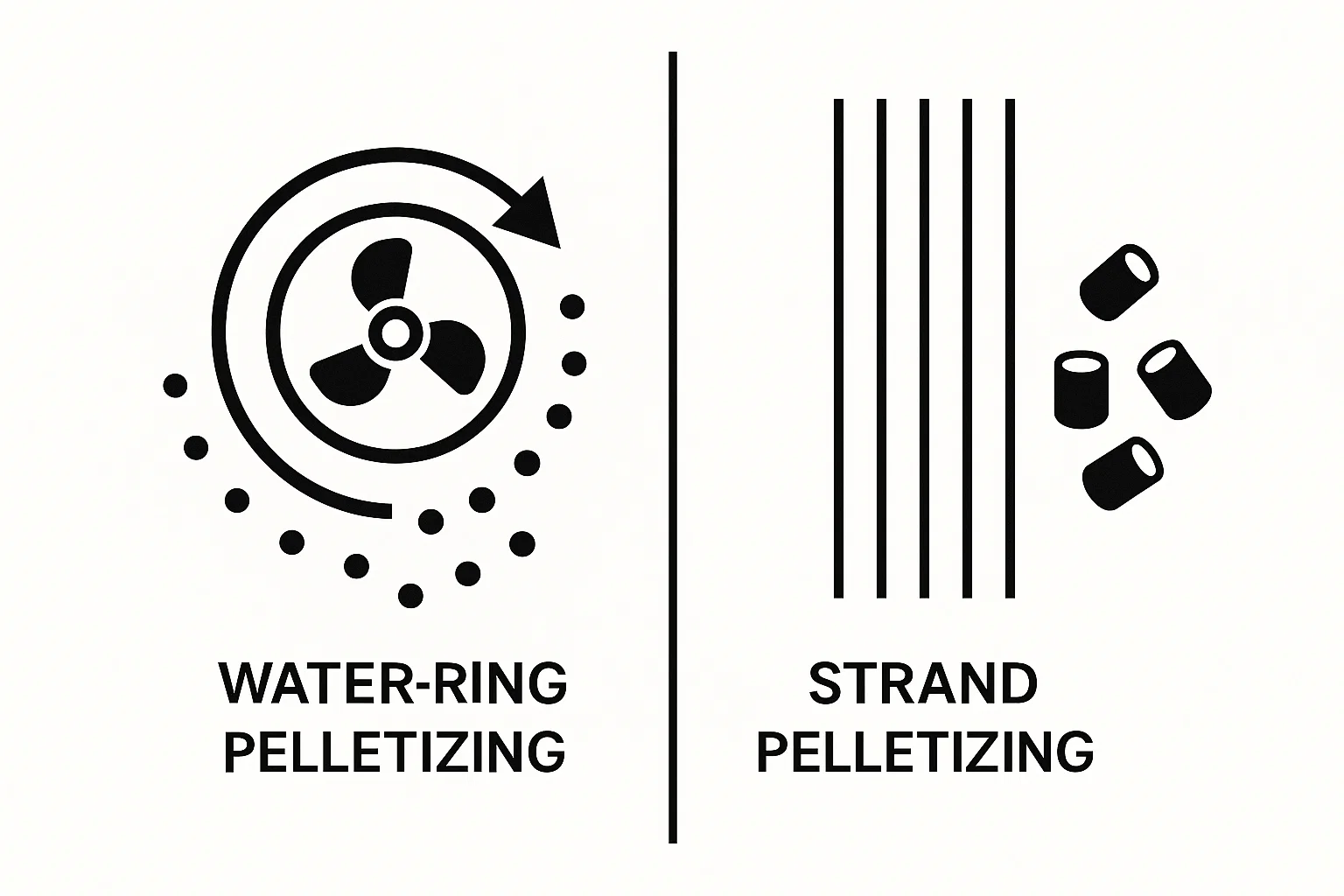
When buyers evaluate plastic pelletizer price, looking only at the initial machine quotation is the most common financial trap in recycling plant procurement. A low-bid equipment quote often masks catastrophic operational costs if the chosen pelletizing method does not match your feedstock’s melt behavior. The true commercial choice between water ring die-face cutting and cold strand pelletizing hinges on Total Cost of Ownership (TCO): initial capital expenditure (CAPEX), operator labor headcount, purge scrap losses during changeovers, building footprint costs, and line downtime.
At Rumtoo, this decision is evaluated at the engineering RFQ stage. The critical question is never just “Which machine has a lower purchase price?”, but rather “Which pelletizing route produces qualified pellets at the lowest cost per metric ton for my specific polymer mix?”
To explore complete line architectures, review Rumtoo’s turnkey recycling pelletizing lines, our specialized film compacting pelletizing line for flexible plastics, and our heavy-duty hard plastic pelletizing line for rigid regrinds.
Capital Cost Breakdown: Water Ring vs. Strand Systems
Understanding the machinery price gap requires examining the mechanical components included in each system. Water ring pelletizing systems integrate cutting, cooling, water circulation, and centrifugal dewatering into a compact, automated module. In contrast, strand pelletizing systems decouple each stage along an open floor layout (extrusion die, extended water cooling bath, air knife blowers, and mechanical rotary strand pelletizer).
The table below provides realistic industrial price benchmarks for commercial recycling lines:
| Capacity Bracket | Strand Pelletizing System (CAPEX) | Water Ring Pelletizing System (CAPEX) | Typical Price Premium for Water Ring |
|---|---|---|---|
| Small Lines (250 – 450 kg/h) | $28,000 – $45,000 | $38,000 – $62,000 | +25% to +35% |
| Medium Lines (500 – 900 kg/h) | $48,000 – $75,000 | $65,000 – $98,000 | +20% to +30% |
| High-Capacity Lines (1,000 – 1,800 kg/h) | $78,000 – $120,000 | $105,000 – $155,000 | +20% to +28% |
Note: Pricing represents standalone pelletizing cutting, cooling, and dewatering subsections (including die head, cutter/bath, dewatering sieve/centrifuge, and piping). Extruder, screw drives, and screen changers are priced separately.
Total Cost of Ownership (TCO) Comparison Matrix
Initial purchase price represents less than 15% of the total operating costs of a pelletizing line over a five-year lifecycle. The table below details where real plant expenditure accumulates:
| Cost Factor | Water Ring Pelletizer | Strand Pelletizer | Operational Impact & Rationale |
|---|---|---|---|
| Initial Machine CAPEX | Higher ($38k – $155k) | Lower ($28k – $120k) | Water ring incorporates precision cutter hub, pneumatic die-face clamping, and closed-loop dewatering centrifuge. |
| Direct Labor Requirement | 0.25 to 0.5 operator / line | 1.0 to 2.0 operators / line | Strand lines require operators to manually catch, tension, and feed extruded strands into cooling baths during startup and after breaks. |
| Start-up & Breakage Scrap | Very Low (< 0.5% scrap) | High (2.0% – 5.0% scrap) | Every strand break dumps molten polymer onto the floor until the operator re-threads the entire die plate. |
| Footprint & Real Estate | Compact (4 – 7 meters length) | Long (12 – 20 meters length) | Strand cooling baths require 8–15 meters of linear floor space, inflating building leasing and heating costs. |
| Blade Consumable Costs | $800 – $1,800 / year (flexible blades) | $1,500 – $3,500 / year (heavy multi-tooth rotor) | Strand rotary cutter blades require off-site precision grinding; water ring blades are inexpensive and easily replaced in 15 minutes. |
| Cooling Energy & Water Loss | Minimal; closed-loop heat exchanger | High evaporative loss from open baths | Open strand troughs experience continuous steam evaporation and water splash. |
| Maintenance Downtime | Fast cleaning; swing-open die face | High; cleaning tangled strands and bath guides | Detailed maintenance procedures are outlined in our pelletizer maintenance checklist. |
Why Strand Systems Look Cheaper but Can Cost More in Practice
A strand pelletizer appears mechanically simpler on paper: molten polymer exits an orifice die head as continuous spaghetti-like strands, enters an open water bath for cooling, passes under an air knife dryer, and enters a high-speed rotating knife-roll pelletizer.
However, strand systems rely entirely on melt tensile strength. For a strand to travel 10 to 15 meters through water without breaking, the polymer must have high melt strength, moderate-to-low Melt Flow Index (MFI), and high thermal stability.
The Hidden Financial Drain: Strand Breakage
When processing post-consumer flexible films (LDPE, LLDPE, PP woven bags):
- Low Melt Strength & Melt Surges: Recycled film melts are often soft and stretchy. A minor temperature surge or bubble causes the strand to neck down, stretch, and snap.
- Contamination & Gel Inclusion: Small unmelted gel particles, crosslinked bits, or paper fibers instantly fracture thin 3 mm strands.
- The Strand Drop Domino Effect: When one strand breaks, it wraps around neighboring strands, dragging 10 to 30 strands into a tangled mess. Molten polymer piles up at the die head as heavy purge lumps.
- Labor & Scrap Penalty: Operators must stop feeding, purge the die, manually catch the strands with heat-resistant gloves, drag them across the water tank, and re-feed them into the rotating granulator nip rolls. In an 8-hour shift, 3 to 5 strand breaks can generate 100 to 250 kg of degraded startup scrap, costing $120 to $300 daily in lost polymer value and labor.
Why Water Ring Pelletizing Wins for Flexible Polyolefins
In a water ring pelletizer, molten plastic strands never travel unsupported through air or open water troughs.
- Die-Face Hot Cutting: Melt passes through circular die holes and is sliced immediately upon exit by high-speed rotating blades operating in flush contact with the hardened die plate.
- Centrifugal Water Curtain: A high-velocity water ring flows along the perimeter of the circular cutting chamber. The moment pellets are cut, centrifugal force flings them outward into the swirling water curtain, instantly quenching the pellet surface and washing them into a slurry pipe.
- Zero Strand Management: There are no strands to catch, guide, or pull. Even if melt flow fluctuates, pellets continue to form. Startup is push-button automated.
- To compare horizontal vs. vertical layouts, read our comprehensive vertical vs. horizontal water ring pelletizer guide and our foundational water ring plastic pelletizer guide.
Feedstock Compatibility Decision Matrix
Selecting between water ring and strand pelletizing should be guided strictly by polymer physical properties and melt rheology:
| Polymer Feedstock | Recommended Pelletizer Type | Engineering Justification |
|---|---|---|
| Post-Consumer LDPE / LLDPE Film | Water Ring (Hot Die-Face) | Low melt strength; high elongation causes excessive strand breakage. |
| PP Woven Bags / Raffia | Water Ring (Hot Die-Face) | High orientation makes strands brittle; water ring eliminates strand tensioning. |
| HDPE Bottle Flakes / Milk Jugs | Strand OR Water Ring | High melt strength runs well on strands; water ring chosen if plant space is tight. |
| Rigid PP Caps / Crates / Pails | Strand Pelletizer | Moderate-to-high stiffness; strands cool cleanly in water bath. |
| ABS / PS / HIPS Regrind | Strand Pelletizer | Amorphous stiffness allows easy strand pulling; produces classic cylindrical pellets. |
| PET Flakes (Bottle-to-Bottle/Fiber) | Strand or Underwater | Extremely sensitive to water-ring face temperature; requires precise strand quench. |
RFQ Checklist: What to Demand from Machinery Suppliers
When requesting quotations from equipment manufacturers, never compare headline prices without standardizing these 5 engineering criteria:
- Die Plate Metallurgy & Heating Method: Is the die plate made of bimetallic tungsten carbide alloy (HRC 62–65) or standard nitrided steel? Are heaters high-density ceramic bands or cast bronze?
- Cutter Blade Clamping Mechanism: Does the cutter hub feature automatic pneumatic or spring-loaded axial clamping to maintain blade-to-die contact without manual micrometer re-adjustment?
- Dewatering Centrifuge Inclusion: Does the water ring quote include a heavy-duty stainless steel centrifugal spin dryer and dewatering vibrating screen, or is that priced as an optional add-on?
- Water Recirculation System: Is the system equipped with an automated bag filter and stainless plate heat exchanger to keep process water clean and cool?
- Usable Pellet Guarantee: What percentage of fines (< 1 mm) and agglomerates (“doubles/chains”) does the manufacturer guarantee in continuous operation?
Frequently Asked Questions
Why do European and American buyers prefer water ring pelletizers for film?
Because high labor wages ($25–$45/hour) make strand pelletizing financially unviable on film recycling lines. Water ring systems allow a single line operator to manage two or three extrusion lines simultaneously, saving tens of thousands of dollars in payroll every year.
Can a strand pelletizer produce uniform pellets from mixed film scrap?
Rarely. Mixed post-consumer film has fluctuating MFI and moisture content. As melt viscosity shifts, strands expand or contract unpredictably, producing thick “dog-bone” pellets, excessive fines, and frequent strand breaks.
What is the difference between water ring and full underwater pelletizing?
A water ring pelletizer cuts pellets in air inside a chamber with a surrounding water curtain on the outer wall; the die face is heated and not submerged. Full underwater pelletizers submerge the entire die plate under water. Underwater systems are significantly more expensive ($180,000+ CAPEX) and are reserved for ultra-high throughputs (2,000+ kg/h) or low-viscosity polymers like hot-melt adhesives and TPU.
Maximize Your Recycling ROI with Rumtoo
Choosing the correct pelletizing technology protects your profit margins, eliminates operator frustration, and guarantees premium, dust-free recycled pellets for your end customers.
Contact the Rumtoo Sales & Engineering Team today for detailed machine proposals, layout engineering, and turnkey plastic recycling pelletizing lines.
- plastic pelletizer price
- water ring pelletizer
- strand pelletizer
- pelletizing line cost
- recycling equipment buyer guide