
· Rumtoo Engineering Team · Process Engineering · 8 min read
Why Plastic Film Recycling Lines Need a Cutter Compactor
Soft film does not feed like rigid flake. Learn the thermo-mechanical physics of cutter compactors, tangential extruder force-feeding, Rumtoo CC series specifications, and how compaction stabilizes melt pressure and pellet quality.
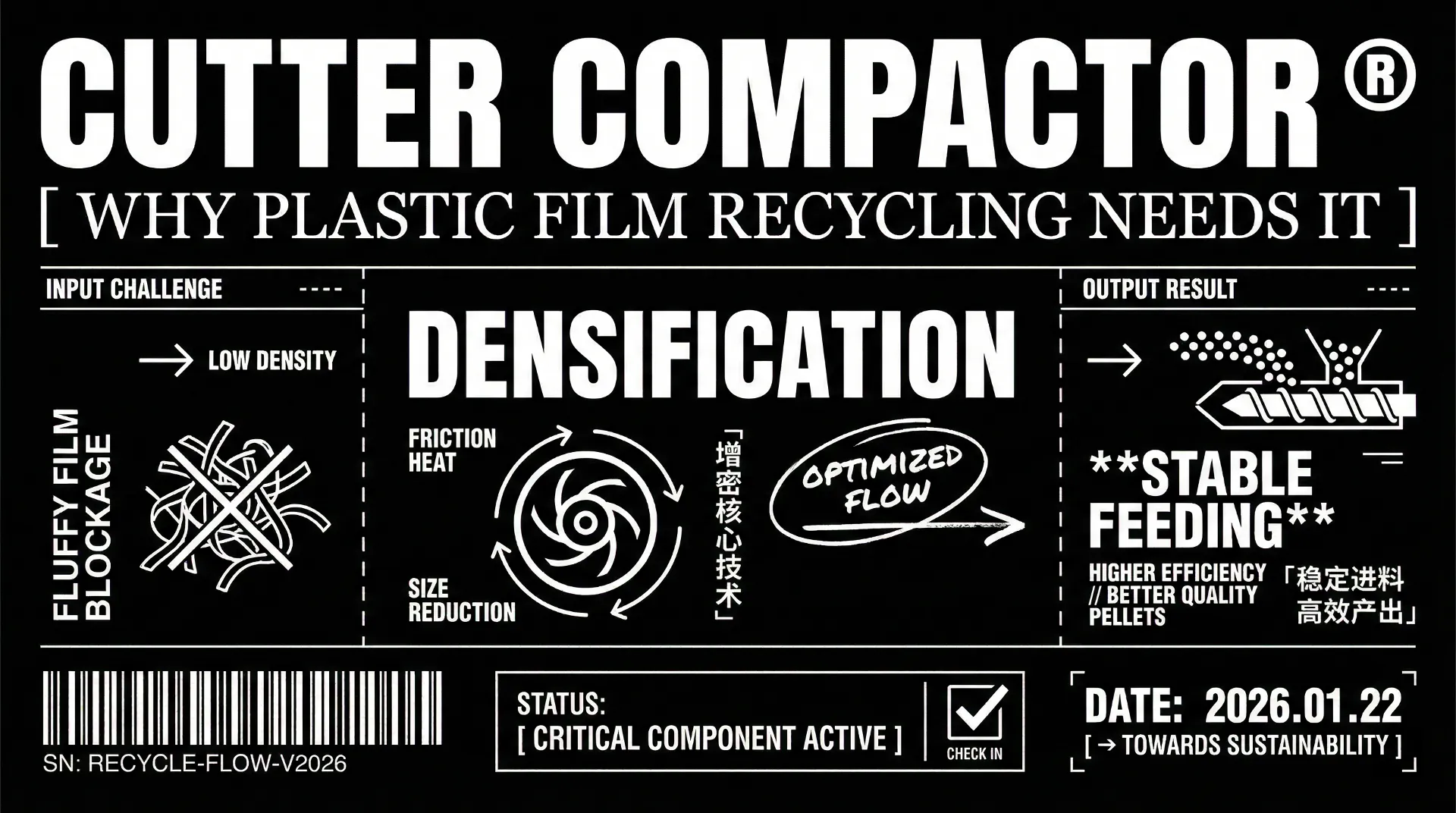
Every industrial plastic film recycling line eventually encounters the same operational hurdle: lightweight, flexible polymer scrap cannot be fed into an extrusion screw like rigid bottle flakes or dense regrind. Flexible materials—such as LDPE packaging film, agricultural greenhouse sheeting, LLDPE stretch wrap, PP raffia, and woven FIBC big bags—have an extremely low bulk density (often 20 to 40 kg/m³), high elastic resilience, and a stubborn tendency to entangle.
When operators attempt to dump loose film shreds into a standard gravity hopper or vertical feed throat, the material arches, hangs up on barrel walls, and forms bridges. The extruder alternates between starvation and surging, generating severe melt-pressure swings, surging motor loads, and irregular pellets.
A cutter compactor (integrated agglomerating and shredding drum) solves this fundamental bottleneck. Directly coupled to the extruder feed section, it converts light, fluffy film into pre-heated, dense, free-flowing shreds and force-feeds them tangentially into the screw flights.
For complete line configurations, explore Rumtoo’s turnkey film compacting pelletizing line, dedicated BOPP plastic pelletizing system for high-speed edge trims, and our high-efficiency plastic film and bag recovery line. If your operation processes rigid materials alongside film, compare our dedicated hard plastic pelletizing line.
The Mechanics & Physics: How a Cutter Compactor Operates
A cutter compactor is not merely a high-speed shredder; it is a thermo-mechanical conditioning reactor operating below the polymer’s melting point ($T_m$). The process follows four synchronized stages:
[Infeed Conveyor / Roll Feeder]
               │
               ▼
┌───────────────────────────────┐
│     CUTTER COMPACTOR DRUM     │
│  - Rotor & Stator Shearing    │ ───► Steam / Moisture Vent Exhaust
│  - High-Speed Vortex Flow     │
│  - Frictional Pre-Heating     │
│    (85°C – 110°C)             │
│  - Bulk Densification         │
│    (30 kg/m³ ➔ 320 kg/m³)     │
└──────────────┬────────────────┘
               │ Centrifugal Tangential Injection
               ▼
┌───────────────────────────────┐
│     EXTRUDER SCREW INTAKE     │
│  - 100% Screw Flight Filling  │
│  - Reduced Plasticizing L/D   │
│  - 25–35% Extruder Power Save │
└───────────────────────────────┘
1. High-Speed Shearing and Vortex Generation
At the base of a heavy cylindrical chamber, a heavy-duty rotor disc equipped with multiple tool-steel knives rotates at 600 to 1,200 RPM (peripheral blade speeds reach 35 to 50 m/s). Stationary stator knives mounted along the chamber perimeter continuously shear against the rotating blades. The intense rotational kinetic energy forces the film into a swirling aerodynamic vortex, drawing shreds down into the cutting zone and propelling them upward along the outer walls.
2. Frictional Pre-Heating and Conditioning
As polymer fragments repeatedly collide and undergo high-shear slicing, mechanical friction converts directly into heat. The internal temperature of the film rises quickly to 85°C–110°C for PE and 110°C–130°C for PP. This temperature remains safely below the melting point, reaching the polymer’s Vicat softening region without inducing thermal degradation or polymer chain scission.
3. Flash Moisture Evaporation
Surface moisture remaining from upstream washing stages (up to 3–5% moisture by weight) flashes rapidly into steam inside the hot vortex. An exhaust ventilation hood and vacuum extraction duct mounted atop the compactor chamber continuously vent this moisture out of the system before the polymer reaches the extruder screw. This drastically reduces the degassing burden on downstream extruder vacuum ports.
4. Bulk Densification and Tangential Force-Feeding
Soft film shrinks, collapses, and rounds into dense, semi-agglomerated granular particles. The bulk density surges from 25–40 kg/m³ up to 280–380 kg/m³—an increase of nearly 800% to 1,000%. High centrifugal force flings these pre-heated, dense shreds tangentially into the extruder intake port at 100% flight capacity.
Rumtoo CC Series Cutter Compactor Specifications
Rumtoo integrates heavy-duty CC series compactors directly with single-screw and twin-screw pelletizing extruders:
| Technical Parameter | CC-300 System | CC-500 System | CC-800 System | CC-1200 System |
|---|---|---|---|---|
| Nominal Throughput Range | 200 – 350 kg/h | 450 – 700 kg/h | 750 – 1,100 kg/h | 1,200 – 1,800 kg/h |
| Compactor Drum Inner Diameter | 800 mm | 1,100 mm | 1,400 mm | 1,800 mm |
| Compactor Rotor Motor Power | 37 kW (Inverter VFD) | 55 kW (Inverter VFD) | 90 kW (Inverter VFD) | 160 kW (Inverter VFD) |
| Rotor Knives / Stator Knives | 4 rotor / 12 stator | 6 rotor / 18 stator | 8 rotor / 24 stator | 10 rotor / 30 stator |
| Rotor Speed Range | 600 – 1,100 RPM | 500 – 950 RPM | 400 – 850 RPM | 350 – 750 RPM |
| Bulk Density Output | 280 – 340 kg/m³ | 300 – 360 kg/m³ | 310 – 380 kg/m³ | 320 – 390 kg/m³ |
| Permissible Infeed Moisture | Up to 4.0% wt | Up to 4.5% wt | Up to 5.0% wt | Up to 5.0% wt |
| Coupled Extruder Screw Diameter | Ø 85 mm – 100 mm | Ø 100 mm – 120 mm | Ø 130 mm – 150 mm | Ø 160 mm – 180 mm |
| Specific Energy Consumption | 0.28 – 0.34 kWh/kg | 0.26 – 0.31 kWh/kg | 0.24 – 0.29 kWh/kg | 0.22 – 0.27 kWh/kg |
4 Engineering Advantages of an Integrated Cutter Compactor
1. 100% Screw Filling and Extreme Melt-Pressure Stability
When an extruder barrel receives pre-compacted, pre-heated feed at steady velocity, the screw feed zone is completely packed from the first flight. Melt pressure before the screen changer stabilizes within ±2 to ±3 bar (compared to ±15 to ±30 bar on crammer-fed or gravity-fed extruders). This steady flow prevents melt starvation, eliminates surging, and delivers consistent pellet geometry at the die face.
2. Significant Extruder Thermal Energy Savings
Because material enters the feed throat already pre-heated to 90°C–110°C, the extruder screw requires significantly less mechanical shear and barrel electrical heating to bring the polymer to its melting point. This pre-heating reduces extruder motor load by 15% to 25% and shortens the required effective screw length ($L/D$), lowering melt shear stress and preserving polymer molecular weight.
3. Elimination of Bridging and Factory Labor
Loose film requires manual prodding, vibratory hopper pads, or vertical crammer screws that frequently jam when film wraps around the auger shaft. An integrated cutter compactor runs fully automated: an optical infrared sensor or load-cell belt adjusts feeding speed in real-time based on compactor motor amperage, ensuring smooth 24/7 continuous production with zero manual operator intervention.
4. Ideal Pairing with Water Ring Pelletizers
The steady, pulsation-free melt stream generated by a cutter compactor is essential for high-speed water ring plastic pelletizers. Water ring cutting heads require uniform flow across every die orifice; pressure dips cause die hole freeze-offs, while surges cause pellet agglomeration.
Technology Comparison: Cutter Compactor vs. Alternative Feeding Methods
Recycling plant managers often weigh cutter compactors against force feeders, batch agglomerators, and mechanical squeezers:
| Performance Criterion | Integrated Cutter Compactor | Crammer / Side Force Feeder | Offline Batch Agglomerator | Mechanical Screw Squeezer |
|---|---|---|---|---|
| Operating Continuity | 100% Continuous inline | Continuous inline | Batch process (requires operator) | Continuous inline |
| Primary Function | Densification & Force Feeding | Mechanical packing | High-heat densification | Extreme mechanical dewatering |
| Feedstock Flexibility | High (films, bags, raffia, foams) | Moderate (chokes on light stretch) | High (requires manual monitoring) | High (washed wet film flakes) |
| Moisture Handling | Flashes off 3% to 5% surface water | Tolerates < 1.5% moisture only | Flashes off 2% to 4% moisture | Squeezes 30% water down to < 3% |
| Extruder Screw Filling | Excellent (full flights) | Moderate to pulsed | Good | Good (when paired with granulator) |
| Specific Energy Consumption | 0.24 – 0.32 kWh/kg (system total) | 0.35 – 0.42 kWh/kg (higher extruder) | 0.18 – 0.25 kWh/kg (standalone) | 0.08 – 0.12 kWh/kg (dewatering) |
| Labor Overhead | Fully automated PLC control | Frequent manual clearing | High; 1 full-time operator needed | Fully automated PLC control |
For a comprehensive evaluation of upstream dewatering and densification technologies, read our guide on what is densifying in PP/PE film recycling and our detailed overview of film densifiers and squeezers.
Troubleshooting Cutter Compactor Operating Issues
Even well-engineered compactors require proper parameter tuning to avoid common operational traps:
1. Polymer Caking or “Donut” Formation in Drum
- Symptom: Film begins melting prematurely inside the drum, fusing into a solid lump (“donut”) that bogs down the rotor motor.
- Root Cause: Excessive residence time, overfeeding, or running the compactor past the polymer’s melting threshold without discharging into the extruder.
- Engineering Remedy: Activate the automated water-mist injection nozzle to instantly dampen drum temperature by 10°C–15°C; increase extruder screw RPM to pull material out faster; lower rotor inverter frequency.
2. Extruder Under-Feeding / Low Motor Amperage
- Symptom: Extruder motor amperage drops below target; output falls despite full conveyor feed.
- Root Cause: Blunted rotor or stator knives; clearance gap between rotating and stationary blades has exceeded 1.5 mm, resulting in tearing rather than clean cutting.
- Engineering Remedy: Reverse double-edged blades or re-sharpen; recalibrate blade clearance to 0.5 mm – 0.8 mm using a feeler gauge; inspect slide gate position between compactor and extruder barrel.
3. High Melt Pressure Spikes at Extruder Die
- Symptom: Melt pressure surges rhythmically, triggering high-pressure alarms.
- Root Cause: Inconsistent infeed conveyor speed delivering intermittent slugs of heavy film rolls followed by fluffy scrap.
- Engineering Remedy: Link the infeed conveyor VFD motor to the compactor motor amperage feedback loop in the PLC. If compactor load exceeds 85%, the conveyor automatically slows down to maintain constant mass flow.
Buyer Checklist: What to Specify in a Cutter Compactor RFQ
When requesting quotations for a film compacting extrusion line, insist on these critical specifications:
- Drum Wear Liner: Ensure the lower 400 mm of the compactor drum features a replaceable wear-resistant liner (AISI 304 stainless steel or Hardox 450) to resist abrasive silica and dirt in post-consumer films.
- Automated Water Mist Cooling: Insist on a closed-loop pneumatic water mist injection system with solenoid control to prevent polymer melt-downs during sudden extruder stops.
- Pneumatic / Hydraulic Slide Gate: The tangential connection between the compactor and extruder must include an adjustable slide gate to control residence time and material pressure.
- Tool-Steel Blade Metallurgy: Specify premium alloy knives (SKD-11, D2, or tungsten carbide inserts) hardened to 58–62 HRC, with reversible double-cutting edges.
Maximize Film Recycling Output with Rumtoo
A cutter compactor is the bridge that converts fluffy, unwieldy plastic film into steady, high-profit recycled pellets. By densifying, drying, pre-heating, and force-feeding in a single automated step, it unlocks the maximum throughput of your extrusion line.
Contact the Rumtoo Engineering Team today for line sizing consultations, material trial tests, and turnkey film compacting pelletizing lines.
- cutter compactor
- plastic film recycling machine
- film compacting pelletizing line
- PE film recycling
- PP woven bag recycling