
· Rumtoo Engineering Team · Technical Guide · 7 min read
What Is Densifying in PP and PE Film Recycling?
Densifying turns washed PP and PE film into a drier, denser feedstock that pelletizing lines can run more consistently. Learn what densifying does, where it fits in the process, and when your film line needs it.
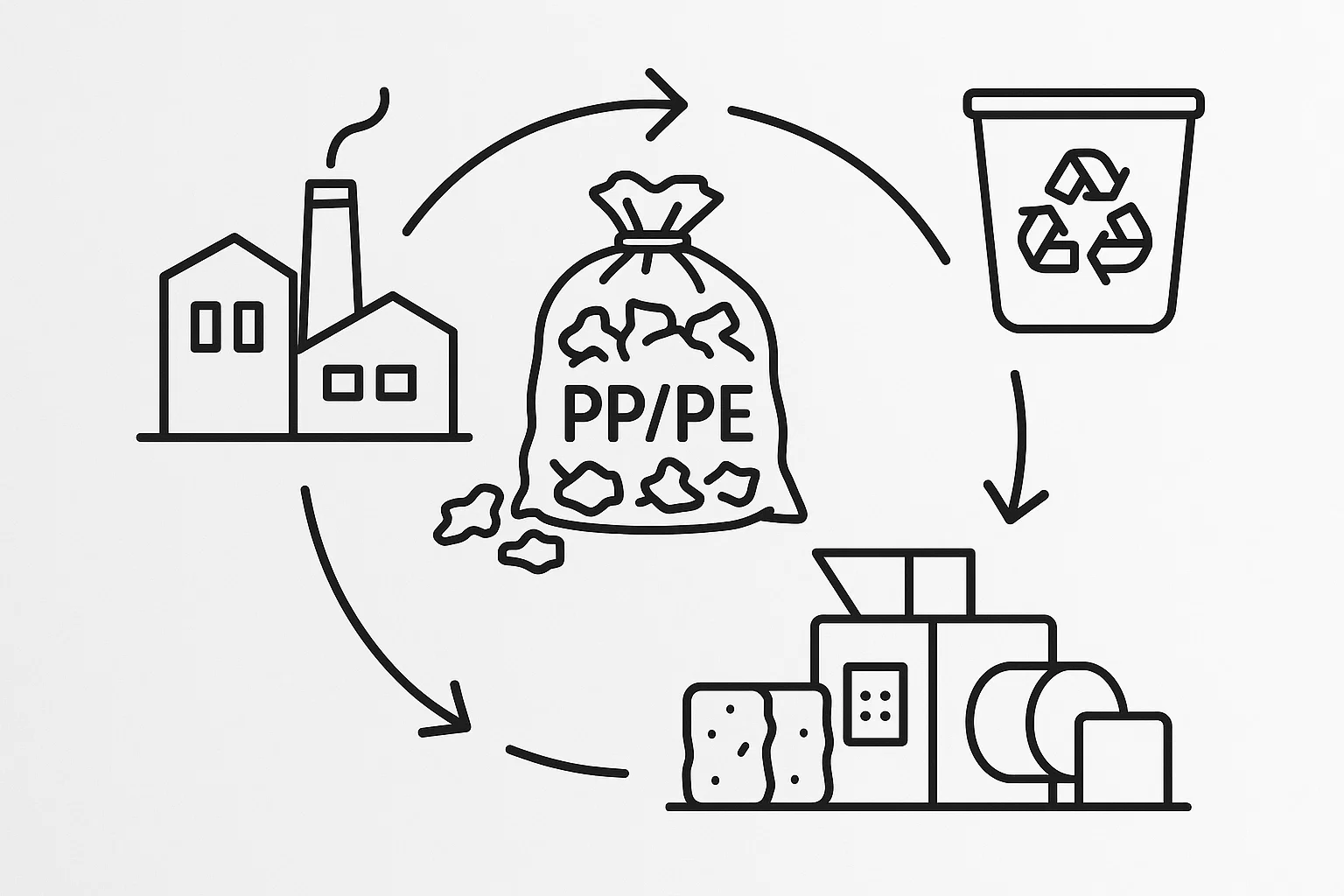
In post-consumer and post-industrial flexible plastic recycling, densifying refers to the mechanical and thermodynamic process of converting lightweight, fluffy, and washed polymer film into a dense, dry, and free-flowing intermediate granulate prior to extrusion. For polyethylene (LDPE, LLDPE, HDPE) and polypropylene (PP) films, densification is not just a secondary convenience—it is the technological bridge that makes continuous, high-output pelletizing commercially viable.
Washed film leaves standard washing stages with two major handicaps: an extremely low bulk density of only 30 to 60 kg/m³ and high residual moisture trapped in creases (15% to 25%). If fed directly to a conventional extruder, fluffy film bridges in the hopper, starves the screw flights, causes severe pressure surging at the die head, and degrades melt quality.
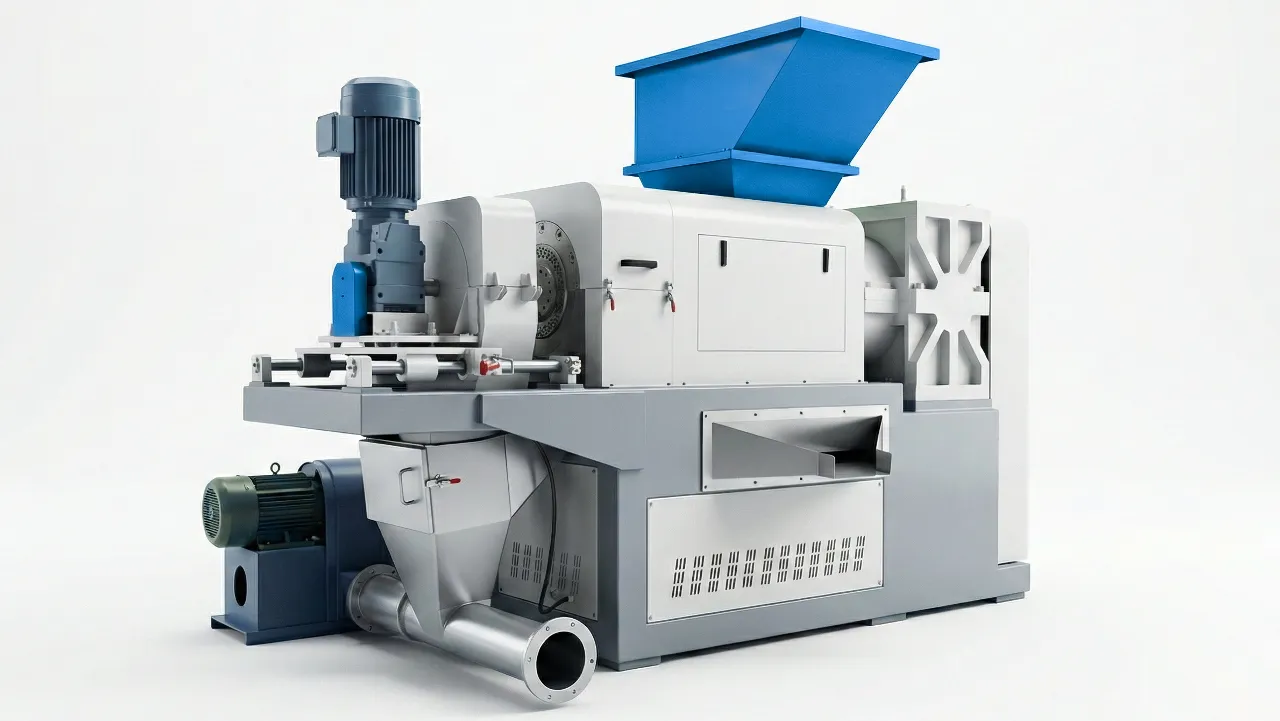
Rumtoo engineers integrate specialized drying and densifying units and continuous film densifiers and squeezers between the agricultural and stretch film washing line and the downstream film compacting pelletizing line. For a complete evaluation of dewatering machines, review our guide on how to choose dewatering equipment for plastic film recycling and our technical analysis of plastic film squeezer technology.
The Physics of Densification: Why Washed Film Resists Direct Extrusion
To understand why densifying is essential, one must look at the mechanics of single-screw and twin-screw extruder feed zones:
- Volumetric Screw Filling (Bulk Density Mismatch): An extruder screw conveys plastic based on the volume of its feed channel and the bulk density of the incoming resin. Standard virgin pellets have a bulk density of 500–550 kg/m³. Shredded film flakes have a bulk density of barely 40–60 kg/m³. A screw that easily discharges 800 kg/h of rigid flake will struggle to output 250 kg/h of fluffy film simply because the flight channels cannot physically swallow enough mass per revolution.
- Friction and Drag Flow Coefficient: Smooth, flat film flakes tend to slide against screw root surfaces rather than tumbling forward under plug-flow drag. This causes erratic feeding, screw starvation, and surging.
- Air Entrainment in the Melt: Loose film flakes carry enormous amounts of interstitial air into the barrel. This air must be vented, frequently overloading vacuum ports and causing molten polymer eruptions.
- Capillary Moisture Retention: Centrifugal spin dryers can remove free water, but flexible film folds over itself, locking in 10%–18% moisture that can only be expelled through thermomechanical compaction.
Densifying solves all four problems simultaneously: it forces air out, compresses flakes together, heats the polymer past its softening point to collapse voids, and delivers a material with a bulk density of 280 to 420 kg/m³.
Technical Comparison of Core Densification Technologies
Industrial recyclers utilize four main approaches to densify PP and PE films. Each operates on distinct mechanical principles and suits different production scales:
| Feature / Parameter | Continuous Screw Squeezer (Squeeze Dryer) | Traditional Batch Agglomerator (Pot) | Integrated Cutter-Compactor Drum | Cold Mechanical Briquetter |
|---|---|---|---|---|
| Operating Principle | High-torque progressive screw press with hydraulic backpressure cone | High-speed spinning floor knives generating frictional heat + cold water shock | Spinning cutter disc at the base of a vertical feed drum directly coupled to extruder | Hydraulic or mechanical piston compressing dry flake into high-density pucks |
| Operational Mode | 100% Inline Continuous 24/7 | Discontinuous Batch (15–30 min cycles) | Continuous Inline (Direct Extruder Feed) | Continuous or Batch Inline |
| Infeed Moisture Capability | 15% – 35% (handles soaking wet film) | < 5% – 8% (requires pre-drying) | < 3% – 6% (handles damp flakes) | < 1.5% (strictly dry film only) |
| Discharge Moisture | 1.5% – 3.5% | < 1.0% | 1.0% – 2.0% | Unchanged (same as infeed) |
| Output Bulk Density | 280 – 400 kg/m³ | 300 – 420 kg/m³ | 250 – 350 kg/m³ | 450 – 600 kg/m³ |
| Product Physical Form | Porous, popcorn-like granular chunks | Irregular, sintered gravel-like grains | Sintered, pre-heated compressed flakes | Solid cylindrical pucks / briquettes |
| Specific Energy Consumption | 35 – 50 kWh / metric ton | 80 – 140 kWh / metric ton | 45 – 65 kWh / metric ton | 20 – 35 kWh / metric ton (compression only) |
| Labor Requirement | Fully automated; zero dedicated operator | High; requires skilled operator per shift | Fully automated; PLC integrated | Low; automated packaging |
| Thermal Degradation Risk | Low; brief residence time (5–8 seconds) | High; prone to thermal scorching & degradation | Low; controlled dwell time in drum | Zero (ambient temperature) |
How Densifying Transforms the Recycling Process
1. Extrusion Throughput Multipliers
By replacing 50 kg/m³ fluffy film flakes with 350 kg/m³ densified granules, the extruder screw feed zone achieves complete channel filling on every turn. In typical field retrofits, adding an inline densifier boosts extrusion line output by 25% to 50% without upgrading the extruder gearbox or motor.
2. Radical Reduction in Drying Energy Costs
Thermal drying via hot air ducts requires ~2,260 kJ per kg of evaporated water. Continuous mechanical screw densifiers press liquid water through perforated barrels using mechanical torque. This mechanical dewatering uses less than 15% of the energy demanded by electric or gas-fired thermal blowers.
3. Elimination of Bridging in Storage Silos
Fluffy film flakes tangle and form structural arches (bridging) in feed hoppers, transfer chutes, and storage silos, requiring continuous manual poking or pneumatic vibrators. Densified granules flow like smooth gravel, allowing automated discharge from mass-flow storage silos.
4. Freight and Logistics Optimization
For operations that wash film at one facility and ship it to a separate compounding plant for pelletizing, transporting un-densified film means shipping 90% air. Densifying increases truckload payload from 5–7 metric tons up to the legal maximum of 20–24 metric tons per container, slashing freight costs by more than 60%.
When Does Your Film Recycling Line Need Densifying?
Densification is recommended whenever processing flexible, low-density plastic streams:
- Post-Consumer LDPE Agricultural Mulch & Silage Wrap: Soil-contaminated, ultra-thin (< 20 microns), and saturated with wash water. Densifying removes moisture and sand while preparing the film for extrusion.
- Post-Commercial Stretch Film (LLDPE): Highly elastic stretch films wrap around shredder rotors and resist gravity feeding. Densifiers collapse the elastic spring memory.
- PP Woven Sacks & FIBC Jumbo Bags (Raffia): High-tensile tapes cause severe bridging. Compacting transforms frayed fibers into solid chips.
- Printed BOPP Packaging Film: Multi-layer, barrier packaging films benefit from pre-compaction to degas volatile ink solvents before the main extruder barrel.
When Is Densifying Unnecessary?
Densification is generally redundant for rigid plastics. If your line handles HDPE milk jugs, PP bottle caps, battery casings, or ABS/PS e-waste regrind, the material already has a bulk density of 350–500 kg/m³. These rigid streams should feed directly into a dedicated hard plastic pelletizing line.
Evaluating Densifiers: Essential Engineering Parameters
When specifying densifying machinery for your recycling plant, demand verified engineering answers from equipment builders:
- Water Handling Architecture: Does the machine feature stainless steel wedge-wire slotted barrels for continuous liquid runoff, or does it attempt to boil water off via thermal heating?
- Wear Protection on High-Shear Components: Are rotating blades, screw flights, and choke cones surfaced with tungsten carbide (PTA) to withstand abrasive silica particles from agricultural films?
- Discharge Sizing Uniformity: Does the system incorporate an adjustable rotary face-cutter to control maximum granule size, preventing oversized agglomerate chunks from jamming extruder throat feeds?
- Integration with Extrusion Controls: Can the densifier’s discharge rate be interlocked via 4–20 mA or Ethernet/IP signals with the extruder feed sensor to prevent hopper overfill?
Frequently Asked Questions
Does densifying melt the plastic completely?
No. High-quality densification produces partial plasticization (sintering). The polymer reaches its softening point (approx. 90°C–110°C for LDPE), allowing the edges of flakes to fuse and compress into porous granules without entering a fully molten state. This preserves the polymer’s molecular weight and prevents thermal degradation.
Can an agglomerator pot be automated?
While modern agglomerators offer automated water-injection sensors, they remain inherently batch machines. Cycle consistency depends on blade sharpness, ambient temperature, and batch loading. In contrast, continuous screw squeezers run 24/7 with zero cycle variations.
What is the difference between a densifier and a cutter-compactor?
A densifier (such as a screw squeezer) is a standalone machine that can discharge material into cooling silos, gaylords, or conveyors. A cutter-compactor is a specialized densifying drum mounted directly onto the feed throat of an extruder, utilizing centrifugal force to fling hot, cut flakes straight into the screw.
Optimize Your Film Recycling Line with Rumtoo
Implementing the right densification step between washing and pelletizing eliminates bottlenecks, stabilizes pellet quality, and dramatically lowers energy consumption per ton.
Contact the Rumtoo Process Engineering Team today for customized plant layouts, material test runs, and turnkey flexible film recycling lines.
- densifying
- PP film recycling
- PE film recycling
- film densifier
- pelletizing