
· Rumtoo Engineering Team · Buying Guides · 7 min read
What Is a Single-Screw Pelletizer for PET Flakes?
A practical guide to single-screw pelletizers for PET flakes. Learn where single-screw PET pelletizing works well, where it falls short, and how to evaluate filtration, drying, and line configuration before investing.
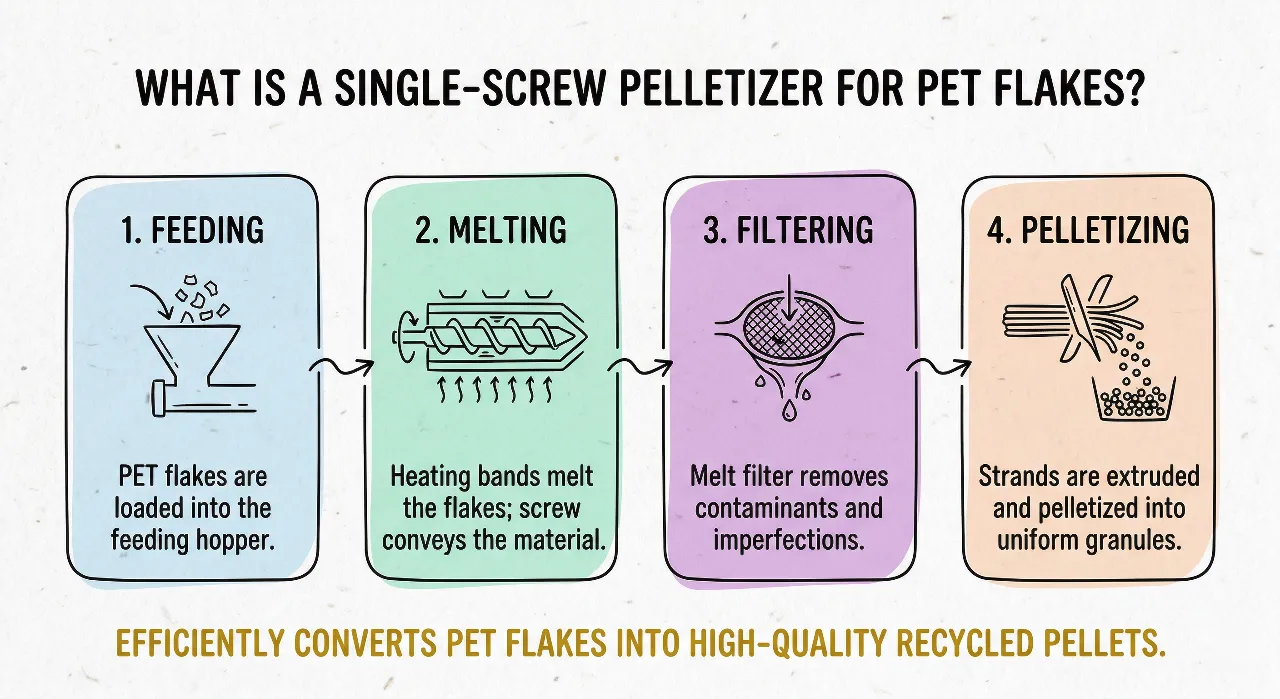
A single-screw pelletizer for PET flakes is an extrusion system engineered to melt, homogenize, filter, degas, and pelletize post-consumer or post-industrial washed PET (polyethylene terephthalate) flakes using a single continuous flighted screw. For the right feedstock and end product, it represents one of the most reliable and cost-effective recycling solutions available. However, when deployed on inconsistent or damp feedstock, it quickly turns into an expensive operational bottleneck.
Before selecting a pelletizer, plant managers must verify that upstream flake preparation is operating under tight process control. Rumtoo’s PET bottle recycling line covers the washing, pre-sorting, and hot-wash liberation required to reach clean flake purity, while our hard plastic pelletizing line and twin-screw extruders show how different extrusion configurations fit specific downstream resin markets.
When single-screw PET pelletizing makes engineering sense
Single-screw extrusion remains the dominant technology in many industrial recycling lines because of its mechanical simplicity, robust drive train, and lower initial capital expenditure (CAPEX). It delivers exceptional return on investment under specific operating conditions:
- Clean, pre-sorted feedstock: Flakes originate from dedicated post-industrial scrap or clear post-consumer beverage bottles with total non-PET contamination below 50 ppm.
- Strictly controlled inlet moisture: Incoming flake moisture is pre-dried to below 50 ppm (0.005%) using a desiccant drying hopper or continuous infrared crystallization dryer before reaching the feed throat.
- Stable bulk density: Flakes have uniform size distribution (typically 8–12 mm) with minimal fines (<1%), ensuring consistent gravity feeding without bridging in the hopper.
- Non-compounding applications: The target pellet will be converted into thermoforming packaging sheet, packaging strapping bands, or staple fiber, rather than complex masterbatches or glass-fiber reinforced compounds.
In these operating scenarios, a single-screw pelletizer provides a straightforward maintenance structure, lower wear-part costs, and lower specific energy consumption (kWh/kg) compared to high-shear twin-screw alternatives.
Why PET preparation matters more than extruder horsepower
PET is far less forgiving than polyolefins like PE or PP when moisture or contamination slips. If damp PET enters a melting extruder, water molecules trigger rapid hydrolytic degradation at typical processing temperatures (260–285°C). Water rapidly cleaves the ester bonds along the polymer chains, crashing the Intrinsic Viscosity (IV) from a respectable 0.78 dL/g down to brittle, unmarketable 0.60 dL/g.
Before PET flakes enter the pelletizer throat, your facility must already have established control gates over the five key parameters detailed in our recycled flake quality control guide:
- Moisture content: Must be dried to <50 ppm for conventional single-screw extruders, or <100 ppm when paired with deep multi-vent vacuum degassing.
- PVC contamination: Must remain strictly below 50 ppm (ideally <20 ppm). At PET melt temperatures, PVC degrades into hydrochloric acid, corroding screw flights and turning the melt dark yellow.
- Fines and residual label fragments: Excess paper or polyolefin labels carbonize against barrel walls, blinding melt screen packs within minutes.
- Ferrous and non-ferrous tramp metal: Even tiny wire fragments can score precision bi-metallic barrel liners or crack tungsten carbide pelletizer knives.
- Bulk density consistency: Flakes with bulk density lower than 280 kg/m³ require force-feeders or grooved feed bushings to prevent screw starvation and melt pressure surging.
If these upstream variables are erratic, no downstream extruder—no matter how expensive—can rescue final pellet quality.
Single-screw vs. twin-screw vs. SSP pelletizing technologies
To understand where single-screw PET pelletizing fits into the broader technology landscape, compare it with alternative extrusion pathways:
| Engineering Parameter | Single-Screw PET Pelletizer | Co-Rotating Twin-Screw Extruder | Direct Flake / SSP System |
|---|---|---|---|
| Inlet Moisture Tolerance | ≤50 ppm (requires pre-drying) | 50–200 ppm (with high vacuum) | Online high-vacuum reactor |
| Intrinsic Viscosity (IV) Drop | -0.06 to -0.10 dL/g | -0.03 to -0.06 dL/g | Stable or upgraded (+0.05 dL/g) |
| Typical L/D Ratio | 32:1 to 36:1 | 40:1 to 48:1 | 44:1 to 52:1 |
| Vacuum Degassing Stages | Single or dual port (-0.09 MPa) | Multi-stage high vacuum (-0.096 MPa) | Continuous deep vacuum (<10 mbar) |
| Compounding Capability | Limited to masterbatch colorants | High filler, glass fiber, additives | Specialized polymerization |
| Target End-Use | Strapping, sheet, staple fiber | Spinning, technical engineering grade | Food-grade bottle-to-bottle |
| Capital Investment (CAPEX) | Baseline ($) | 1.6x – 2.2x ($$) | 3.5x – 6.0x ($$$$) |
| Specific Energy Consumption | 0.28–0.35 kWh/kg | 0.38–0.48 kWh/kg | 0.45–0.60 kWh/kg |
Core engineering subsystems of a high-performance single-screw PET line
1. Barrier screw design and bi-metallic barrel
PET requires gentle, uniform plasticization. High-performance single-screw extruders utilize barrier-flighted screws with Maddock or pin-type mixing sections to ensure complete homogenization without inducing localized shear overheating. Barrels are lined with centrifugal-cast tungsten carbide or nickel-based bi-metallic alloys to resist the abrasive wear caused by PET flake edges.
2. High-vacuum multi-port degassing
Even with pre-dried flakes, residual moisture, volatile acetaldehyde (AA), and trace chemical residues must be extracted from the melt. Modern systems feature dual vacuum degassing ports operating at -0.085 to -0.095 MPa, equipped with liquid ring vacuum pumps and refrigerated condensation traps to condense volatile oligomers before they reach pump impellers.
3. Continuous melt filtration
Because post-consumer PET carries trace particulate contamination, filtration design is just as critical as screw geometry. Single-screw lines incorporate hydraulic continuous dual-piston or rotary disk screen changers with filtration fineness between 80 and 150 mesh (180–100 μm). For automated operations, continuous backflush screen changers allow screen self-cleaning without interrupting melt flow or disturbing strand stability.
4. Underwater strand or water ring cutting
Molten PET has very low melt strength and low viscosity compared to polyolefins, which makes standard water ring die-face cutting challenging unless water temperatures and knife timing are precisely synchronized. For most PET single-screw lines, automatic strand pelletizing or underwater pelletizing with water temperature controlled between 60°C and 75°C prevents premature freezing of die holes while avoiding pellet agglomeration.
Where single-screw systems fall short
A single-screw pelletizer is not suitable when:
- The incoming flakes contain unpredictable moisture levels and the budget does not allow for a dedicated desiccant drying tower.
- The feedstock contains high percentages of mixed polyesters, copolymer PETG, or post-industrial barrier layers.
- The project aims directly for FDA/EFSA food-contact bottle-to-bottle approval without an external Solid State Polycondensation (SSP) decontamination reactor.
- The business plan relies on compounding high percentages of calcium carbonate, carbon black, or reinforcing glass fibers.
In those situations, investing in a co-rotating twin-screw extruder or re-evaluating the plant’s upstream design via our PET bottle recycling project planning guide produces significantly better commercial returns.
Five technical questions to ask machinery suppliers
Before signing an equipment purchase contract, require potential suppliers to provide written guarantees on:
- Maximum allowable inlet moisture: Exactly what flake moisture percentage does the screw guarantee before hydrolytic IV drop exceeds 0.05 dL/g?
- Screen changer filtration area and pressure limit: What is the active filtration area (cm²), and what is the maximum permissible differential pressure (ΔP) before mechanical bypass occurs?
- Specific energy efficiency: What is the total specific electrical power consumption (kWh per metric ton of prime pellet output) across main motor, barrel heaters, and vacuum pumps?
- Degassing vacuum level: What vacuum pump capacity (m³/h) and operating pressure (mbar/MPa) are guaranteed at full throughput?
- Screw and barrel metallurgical warranty: What base materials, hardening depths, and wear-life guarantees are provided for continuous recycling operation?
Frequently asked questions
Can a single-screw extruder process wet PET flakes without pre-drying?
No. Standard single-screw extruders cannot process wet PET flakes (moisture >0.5%) without causing severe hydrolytic chain scission, resulting in unworkable IV loss, excessive foaming at the die head, and brittle pellets. Flakes must either be pre-crystallized and dried in a desiccant dryer to <50 ppm moisture, or processed on specialized vented twin-screw lines equipped with multi-stage vacuum degasification.
How much does Intrinsic Viscosity (IV) drop during single-screw pelletizing?
On properly dried feedstock (<50 ppm moisture) with an optimized barrier screw, IV drop can be kept within 0.05 to 0.08 dL/g (for example, dropping from 0.78 dL/g in the washed flake to 0.71–0.73 dL/g in the finished pellet). Without proper drying, IV drop easily exceeds 0.20 dL/g, rendering the pellets useless for fiber or packaging applications.
Which cutting method is recommended for PET pellets: strand or water ring?
For single-screw PET recycling lines, automatic water-bath strand pelletizing remains the most common and robust approach due to PET’s low melt strength. However, closed underwater pelletizing systems are increasingly adopted on higher-throughput lines (1,000+ kg/h) for their uniform spherical granule shape, reduced operator handling, and automated startup.
Final takeaway
A single-screw pelletizer for PET flakes can be an exceptionally profitable, low-maintenance asset when feedstock quality, pre-drying, and melt filtration are properly engineered. It is not, however, a shortcut to compensate for deficiencies in upstream washing or moisture removal.
If you are evaluating whether single-screw extrusion fits your target pellet specifications and feedstock supply, contact our engineering team. Rumtoo can help audit your flake parameters, design complete wash-to-pellet layouts, and configure the right filtration and pelletizing equipment for your project.
- single-screw pelletizer
- PET flakes pelletizing
- PET recycling
- hard plastic pelletizing line
- recycling pelletizing