
· Rumtoo Process Team · Technical Guide · 8 min read
PVC Pipe Recycling Process: A Mechanical Recovery Guide
Learn the complete mechanical PVC pipe recycling process: from heavy-duty shredding of oversized thick-wall pipes to granulating, washing, zig-zag de-dusting, and pulverizing into clean 30-60 mesh regrind for re-extrusion.
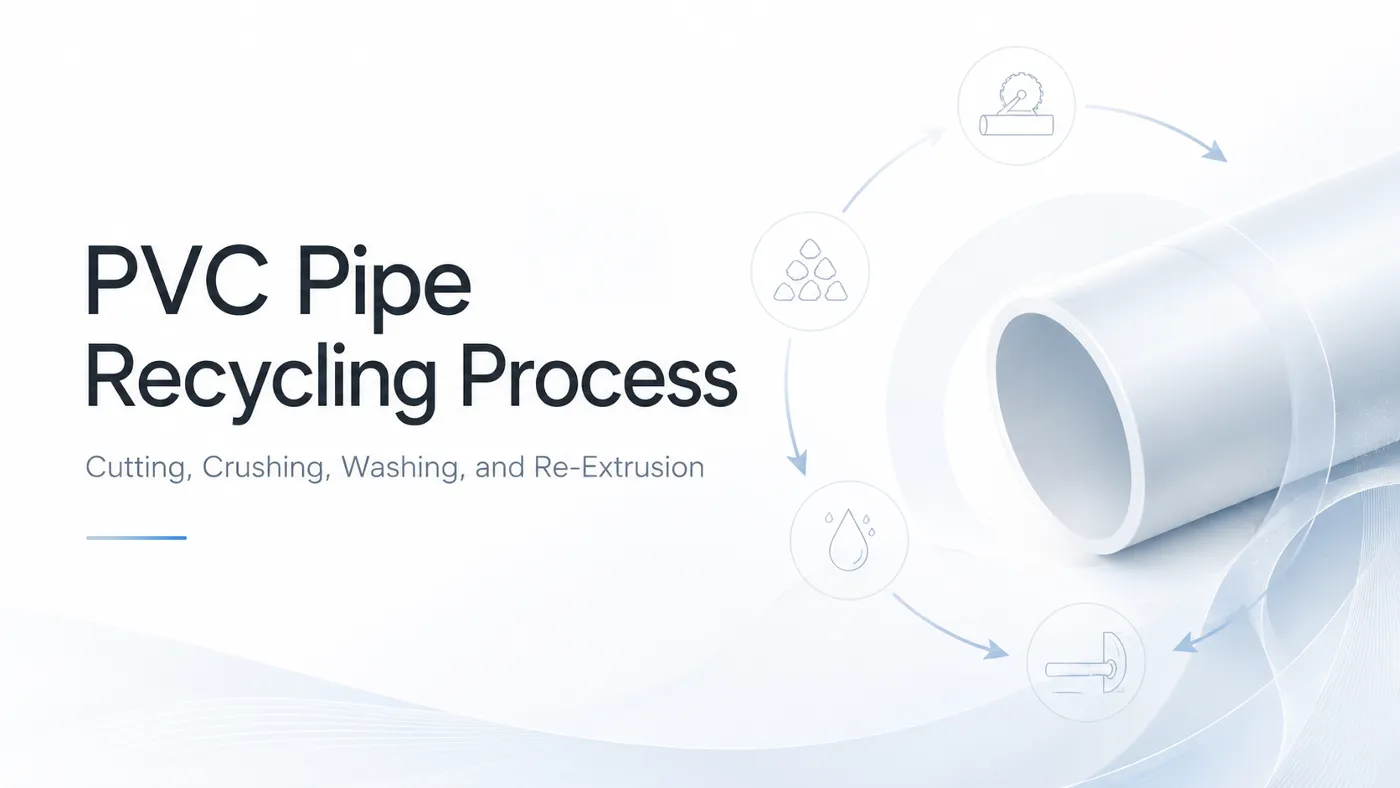
The PVC pipe recycling process is an automated mechanical recovery sequence engineered to reduce thick-walled, rigid polyvinyl chloride scrap into ultra-clean, uniform chips or fine micronized powder. Pipe extruders and municipal utilities generate massive volumes of rigid PVC waste: thick off-specification startup pipes, sewer pipe offcuts, corrugated conduits, and demolished underground utility infrastructure.
Because unplasticized PVC (PVC-U) has high structural stiffness and density (1.38–1.45 g/cm³), bulky 3-to-6-meter pipe lengths cannot be fed into standard recycling machinery. Furthermore, PVC is uniquely heat-sensitive: if excessive friction or localized shear heats the polymer above 180°C–200°C during size reduction, PVC thermally degrades, releasing hazardous, corrosive hydrogen chloride (HCl) gas.
An engineered PVC pipe recycling machine line avoids thermal degradation while managing high concentrations of abrasive mineral fillers (5% to 30% CaCO_3). Recovered PVC pipe regrind can be reintroduced directly into the core layers of multi-layer co-extruded pipes at ratios between 20% and 60%, drastically slashing virgin raw material expenses without sacrificing ring stiffness.
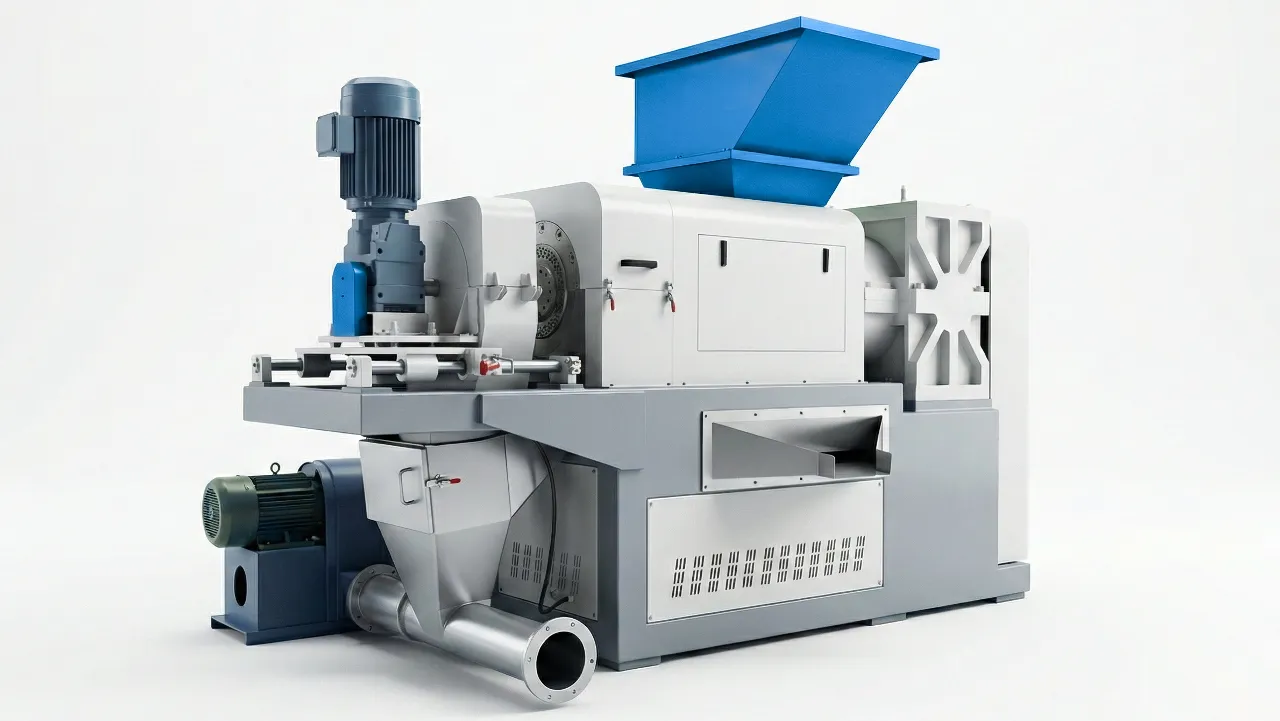
For primary size reduction equipment, explore our specialized vertical crusher for PVC pipes and profiles, heavy-duty industrial shredders, precision plastic crushers, and high-output PVC pulverizers.
The 7-Stage PVC Pipe Mechanical Recycling Process Flow
A continuous industrial PVC pipe recovery plant operates across seven synchronized mechanical phases:
[Long Pipes: 3–6 m lengths, OD 50–1,200 mm]
                    │
                    ▼
┌───────────────────────────────────────────────┐
│ 1. PRIMARY PRE-SHREDDING / CUTTING            │
│    - Horizontal pipe shredder or hydraulic    │
│    - Reduces pipes to 100–300 mm coarse slabs │
└───────────────────┬───────────────────────────┘
                    │ Heavy Belt Conveyor
                    ▼
┌───────────────────────────────────────────────┐
│ 2. SECONDARY PRECISION GRANULATION            │
│    - V-shaped rotor blades, water-cooled      │
│    - 8–12 mm screen classification            │
└───────────────────┬───────────────────────────┘
                    │ Pneumatic Blower
                    ▼
┌───────────────────────────────────────────────┐
│ 3. ZIG-ZAG AIR CLASSIFICATION & DE-DUSTING    │
│    - Opposed air currents remove fines & fluff│
└───────────────────┬───────────────────────────┘
                    │ Magnetic Cross-Belt
                    ▼
┌───────────────────────────────────────────────┐
│ 4. MULTI-STAGE FERROUS & EDDY METAL REMOVAL   │
│    - Extracts embedded screws, rebar, brass   │
└───────────────────┬───────────────────────────┘
                    │ (Post-Consumer Scrap Route)
                    ▼
┌───────────────────────────────────────────────┐
│ 5. SINK-FLOAT SEPARATION & TURBO WASHING      │
│    - Water bath (density cut at 1.0 g/cm³)    │
│    - High-speed mechanical friction scrubbing │
└───────────────────┬───────────────────────────┘
                    │ Dewatering Auger
                    ▼
┌───────────────────────────────────────────────┐
│ 6. CENTRIFUGAL DEWATERING & THERMAL DRYING    │
│    - High-G vertical spin dryer (<0.3% water) │
└───────────────────┬───────────────────────────┘
                    │
                    ▼
┌───────────────────────────────────────────────┐
│ 7. DIRECT RE-EXTRUSION OR PULVERIZING         │
│    - 8–12 mm chips: Co-ex pipe middle layer   │
│    - 30–60 mesh: [PVC Pulverizer](/pulverizers/)      │
└───────────────────────────────────────────────┘
Detailed Step-by-Step Mechanical Recovery Breakdown
1. Primary Pre-Cutting of Long & Large-Diameter Pipes
Handling 6-meter long pipes with outside diameters (OD) between 160 mm and 1,200 mm is the most difficult physical challenge in pipe recycling. Standard gravity hoppers jam instantly.
- Horizontal Hydraulic Pipe Shredders: Long pipes are loaded horizontally into an enclosed trough. A heavy hydraulic ram presses the pipe horizontally against a low-speed, high-torque rotor (typically 25–40 RPM). Specially profiled concave cutting teeth shear the pipe wall into 100–300 mm curved chunks without generating heat.
- Vertical Feed Pipe Crushers: For thin-to-medium wall conduits (OD up to 250 mm), a vertical crusher for PVC pipes allows pipes to be fed vertically without pre-cutting, pulling the pipe into the chamber via rotor draw.
2. High-Efficiency Precision Granulation
The pre-shredded chunks enter a heavy-duty granulator equipped with an open or semi-closed rotor configured in a double-scissor or V-chevron arrangement.
- Scissor Action Cutting: Counter-shearing between stationary bed knives and rotor blades cuts rigid PVC with minimal impact shattering, keeping fine dust generation below 3%.
- Chamber Water-Cooling: Because PVC softens and burns easily, granulator bearing housings and cutting chamber walls are jacketed with circulating chilled water to keep chamber temperatures strictly below 50°C.
- Interchangeable Screens: A heavy manganese steel perforated screen plate (8 mm to 12 mm hole diameter) ensures that only uniform chips escape the chamber.
3. Zig-Zag Air Classification and Fines Separation
Granulating brittle rigid PVC inevitably generates micro-fines and electrostatic dust. If fed directly into extrusion screws, micro-fines melt prematurely in the feed throat, forming carbonized build-ups that choke the barrel.
- A zig-zag air classifier subjects falling regrind chips to an upward, precisely calibrated laminar air stream. Light dust, plastic paper labels, and micro-fines are carried upward into a cyclone filter, while clean, dense 8–12 mm chips drop out through the bottom rotary airlock.
4. Comprehensive Metal Detection and Magnetic Separation
Post-consumer utility pipes and demolition waste frequently conceal iron nails, stainless steel joining bands, brass fittings, or gravel:
- Overband Rare-Earth Magnet: Suspended over the conveyor belt to continuously extract ferrous debris.
- All-Metal Electronic Detector & Rejection Chute: Scans falling chips for non-ferrous metals (copper, aluminum, stainless steel) and fires high-speed pneumatic ejector nozzles to purge contaminated granules within milliseconds.
5. Wet Washing and Density Separation (Post-Consumer Waste)
Clean factory production pipe scrap skips wet washing. However, excavation and post-consumer demolition pipes coated with dried mud, road grime, and adhesive residues require wet processing:
- Sink-Float Density Separation: Pure rigid PVC has a specific gravity of 1.38–1.45 g/cm³. When submerged in a standard water bath (ρ = 1.0 g/cm³), the heavy PVC sink instantly to the bottom collection auger. Floating contaminants—such as PE/PP film wraps, wood splinters, and rubber gaskets—float on the surface and are skimmed off.
- High-Speed Friction Washer: Sunken PVC chips enter an inclined high-speed rotor (800–1,000 RPM) where heavy water spray and abrasive mechanical friction scrub stubborn dirt, encrusted clay, and adhesives from the plastic surface.
6. Centrifugal Dewatering and Flash Drying
Extruding PVC with surface moisture above 0.2% produces severe steam venting, foaming, voids, and brittleness in finished pipe walls:
- A vertical centrifugal dryer spins at 1,200 RPM, mechanically centrifuging free surface water down to < 1.0%.
- Hot-air cyclone drying ducts drop moisture below 0.15% to 0.20% by weight, delivering bone-dry chips ready for immediate compounding or direct extrusion.
Rumtoo Industrial PVC Pipe Recycling Line Specifications
Rumtoo builds integrated PVC pipe shredding, washing, and granulation lines engineered for high output and extreme mechanical durability:
| Engineering Parameter | PCR-500 Line | PCR-1000 Line | PCR-1500 Line | PCR-2500 Line |
|---|---|---|---|---|
| Nominal Throughput Capacity | 400 – 600 kg/h | 800 – 1,100 kg/h | 1,200 – 1,600 kg/h | 2,000 – 2,800 kg/h |
| Max Processable Pipe Outer Diameter | Up to Ø 250 mm | Up to Ø 450 mm | Up to Ø 800 mm | Up to Ø 1,200 mm |
| Primary Pipe Shredder Motor | 37 kW (Horizontal Ram) | 55 kW (Hydraulic Ram) | 90 kW (Dual-Drive) | 160 kW (Heavy Planetary) |
| Secondary Granulator Motor | 45 kW (V-Rotor) | 75 kW (V-Rotor) | 110 kW (Water-Cooled) | 160 kW (Water-Cooled) |
| Standard Screen Hole Diameter | Ø 8 mm – 10 mm | Ø 10 mm – 12 mm | Ø 10 mm – 14 mm | Ø 12 mm – 16 mm |
| Air De-Dusting Efficiency | >98% fines removal | >98.5% fines removal | >99% fines removal | >99% fines removal |
| Final Regrind Moisture Content | < 0.20% wt | < 0.18% wt | < 0.15% wt | < 0.15% wt |
| Recommended Pulverizer Pairing | 1x SM-500 Pulverizer | 1x SM-800 Pulverizer | 2x SM-800 Pulverizers | 3x SM-800 Pulverizers |
3 Ways to Re-Process PVC Pipe Regrind
Recycled PVC cannot be pelletized using conventional single-screw strand cutters due to heat sensitivity. Processors utilize three proven downstream re-manufacturing paths:
1. Direct Co-Extrusion Blending (8–12 mm Regrind)
In multi-layer pipe extrusion lines, clean 8–12 mm regrind chips are fed into a dedicated secondary conical twin-screw extruder. The regrind forms the thick middle structural layer (often foamed or solid PVC core) representing 40% to 60% of total pipe wall thickness, while virgin resin forms the smooth inner and outer protective skins.
2. High-Precision Pulverizing into 30–60 Mesh Powder
For single-layer pipe extrusion, conduit profiles, and injection-molded drainage fittings, granulate chips must be milled into fine powder. Rumtoo’s disc-type PVC pulverizers mill 8–12 mm chips into uniform 30–60 mesh (250–600 micron) free-flowing powder that blends homogeneously with virgin dry-blend PVC formulations in high-speed turbomixers. Review our detailed PVC pulverizer guide (20–120 mesh) to learn rotor disc clearance and temperature control parameters.
3. Re-Compounding into Pellets
When post-consumer scrap requires the re-addition of impact modifiers (CPE/acrylics), heat stabilizers (Ca/Zn or tin), and processing aids, regrind is fed into a specialized counter-rotating conical twin-screw extruder with an air-cooling hot die-face pelletizing head.
Operational Troubleshooting: Common PVC Recycling Pitfalls
| Problem Observed | Probable Root Cause | Engineering Solution |
|---|---|---|
| Discolored / Yellowed Regrind | Excessive frictional heat during shredding or granulation causing premature thermal degradation. | Activate granulator water-cooling jackets; inspect cutting knives and sharpen dull blades; verify rotor speed is not set too high. |
| Accelerated Blade Wear & Chipping | High abrasive calcium carbonate (CaCO_3) content in drainage pipes or sand/gravel inclusion. | Upgrade blades to vacuum-hardened D2/SKD-11 tool steel or brazed tungsten carbide tips; inspect pre-washing sand separation. |
| Extruder Feed Throat Bridging | Inadequate de-dusting leaving excessive electrostatic micro-fines (< 1 mm) in the regrind chips. | Increase suction velocity in zig-zag air classifier; clean filter bags and verify rotary airlock seal tolerances. |
| Porosity or Steam Bubbles in New Pipes | Residual moisture content exceeding 0.3% in recycled PVC flakes entering the extruder. | Check vertical spin dryer screen for blinding; increase hot-air cyclone heating temperature to 75°C–85°C. |
What to Specify in a PVC Pipe Recycling RFQ
Before investing in a pipe recycling installation, confirm your equipment quotation guarantees:
- Horizontal Pipe Feeding Capability: Heavy-duty pusher rams must have automated load-sensing reverse cycles to handle sudden pipe jams without operator intervention.
- Water-Cooled Granulator Body: The bearing journals and cutting chamber walls must feature internal chilled-water circuits to prevent PVC melting.
- Heavy Manganese / Wear-Resistant Liners: Cutting chambers, blower fan volutes, and pneumatic cyclone ducts must use replaceable wear-resistant steel liners to withstand abrasive
CaCO_3filler dust. - Complete Metal Separation Skid: Both rare-earth overhead neodymium magnets and electronic free-fall all-metal detectors must be integrated into the conveyor transfer stations.
Partner with Rumtoo for Superior PVC Recovery
Whether you are recovering clean factory offcuts or running a municipal post-consumer pipe recycling center, Rumtoo engineers custom-tailored recovery systems with guaranteed throughput and particle consistency.
Contact the Rumtoo Process Team today for personalized plant layout planning, sample shredding trials, and complete turnkey crushers and pipe processing systems.
- PVC pipe recycling process
- PVC pipe recycling machine
- PVC pipe regrind
- PVC pipe washing line
- PVC pipe extrusion scrap recycling