
· Rumtoo Engineering Team · Process Engineering · 7 min read
Plastic Film Squeezer Technology: Why It Matters in Modern Film Recycling
Plastic film squeezer technology reduces moisture, increases bulk density, and stabilizes downstream extrusion. This guide explains how squeeze dryers work, where they fit in a recycling line, and how to evaluate them before buying.
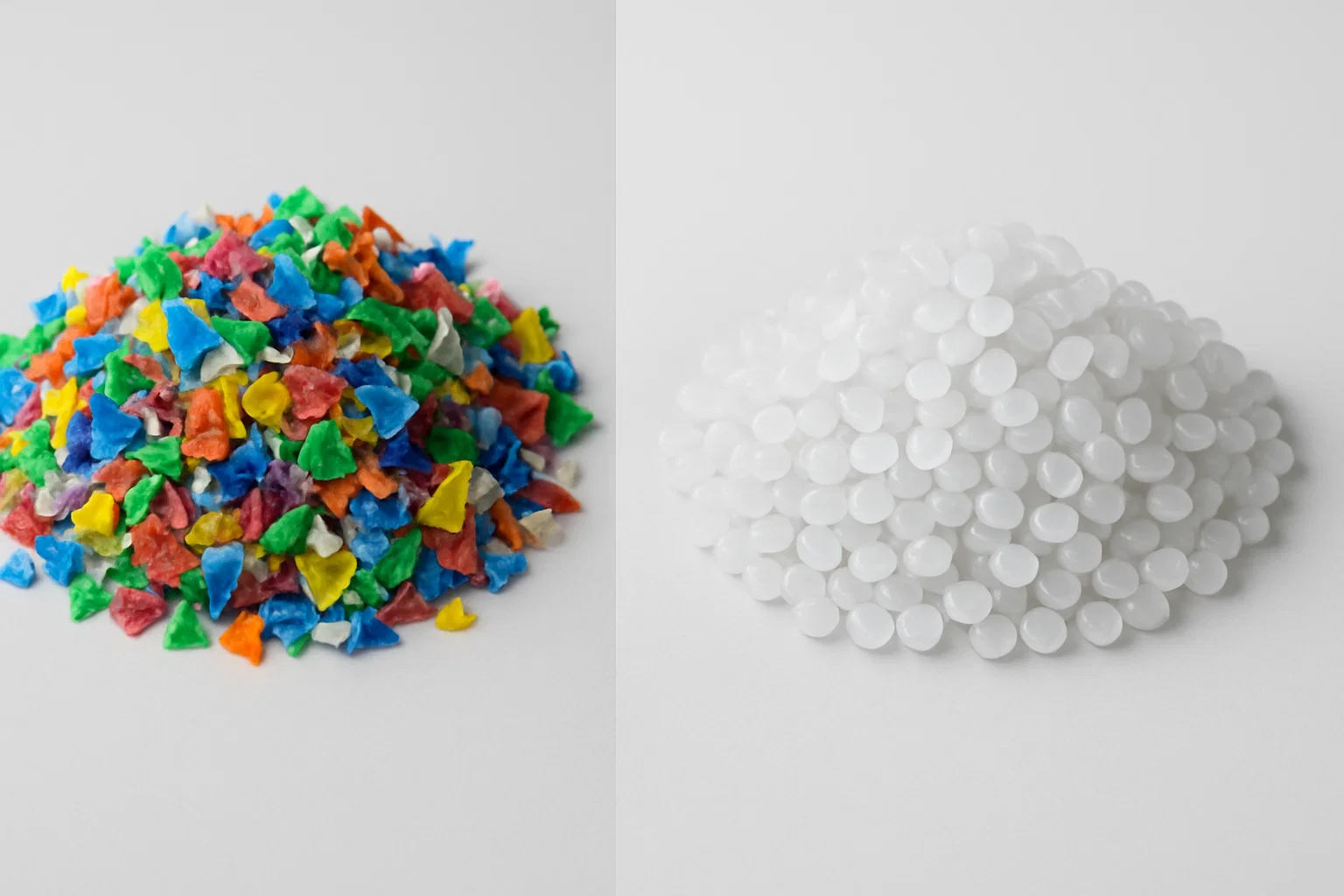
Plastic film squeezer technology (continuous mechanical screw squeeze drying) has become one of the most critical process innovations in modern flexible polyolefin recycling. Washing post-consumer polyethylene (LDPE/LLDPE) or polypropylene (PP) film is relatively straightforward, but preparing washed film flakes for extrusion is notoriously difficult. Washed film leaves conventional friction washers carrying up to 25% moisture, trapped in folds and clinging via surface tension, with an ultra-low bulk density of barely 40 to 60 kg/m³.
When fed directly into an extruder, fluffy, damp film causes bridging at the feed throat, wild melt pressure fluctuations, severe vacuum degassing eruptions, and pellet porosity. Rumtoo’s film densifier and squeezer solves both problems simultaneously: in a single continuous mechanical step, it expels free water, evaporates residual surface moisture through frictional heat, and densifies fluffy film into uniform, easy-flowing semi-plasticized granules.
Pairing a squeezer with an upstream agricultural and stretch film washing line and a downstream film compacting pelletizing line bridges the gap between washing and pelletizing. For a complete system-level overview of drying choices, explore our guide on how to choose dewatering equipment for plastic film recycling and our detailed overview of densification in PP/PE film recycling.
How Squeeze Dryer Technology Works
Unlike centrifugal spin dryers that rely solely on centrifugal acceleration to separate loose droplets, a film squeezer operates on a thermo-mechanical continuous compression principle:
- Forced Screw Infeed: Washed wet film flakes enter the feed hopper where a heavy-duty, high-torque screw pulls the lightweight flakes into the compression barrel.
- Progressive Reduction in Screw Pitch: The hardened alloy screw features a tapering flight depth and narrowing pitch. As material advances, the volumetric space decreases rapidly, generating mechanical pressure exceeding 80 to 120 bar.
- Continuous Hydraulic Backpressure Cone: At the discharge head, a hydraulically controlled restriction cone (or choke ring) exerts variable counter-pressure against the moving plastic plug.
- Liquid Expulsion via Perforated Slotted Barrels: Liquid water is forced out through precision-machined filtration slots (typically 0.2 mm to 0.5 mm wide) positioned along the barrel circumference, draining continuously without allowing plastic flakes to escape.
- Autogenous Frictional Heat (Flash Evaporation): Extreme mechanical shear between the rotating screw, stationary barrel, and dense plastic plug generates autogenous heat (80°C to 110°C). This heat flash-evaporates residual microscopic moisture within seconds.
- High-Speed Rotary Granulator Head: As the semi-molten, compacted plastic emerges through the die head, a variable-speed rotary cutter slices the extruded strands into dense, porous, popcorn-like granules (bulk density: 280–400 kg/m³) ready for pneumatic conveying.
Technical Specifications: Rumtoo Industrial Squeezer Series
The table below outlines real-world engineering parameters across Rumtoo’s continuous screw squeezer dryer range:
| Technical Specification | SQ-350 Model | SQ-500 Model | SQ-800 Model | SQ-1200 Model |
|---|---|---|---|---|
| Nominal Throughput Capacity | 300 – 450 kg/h | 500 – 700 kg/h | 800 – 1,100 kg/h | 1,200 – 1,800 kg/h |
| Main Screw Drive Motor | 55 kW | 90 kW | 132 kW | 200 kW |
| Screw Diameter | Ø 300 mm | Ø 380 mm | Ø 480 mm | Ø 580 mm |
| Screw L/D Ratio | 8:1 | 9:1 | 10:1 | 10:1 |
| Screw Metallurgy / Coating | 38CrMoAlA (Nitrided + Bimetallic Hardfacing) | 38CrMoAlA + Tungsten Carbide PTA | Tool Steel + Laser Clad Hardfacing | Multi-layer Bimetallic Tungsten Alloy |
| Infeed Flake Moisture Range | 15% – 30% | 15% – 30% | 15% – 30% | 15% – 35% |
| Discharge Product Moisture | 2.0% – 4.0% | 2.0% – 3.5% | 1.5% – 3.0% | 1.5% – 3.0% |
| Bulk Density Output | 260 – 320 kg/m³ | 280 – 360 kg/m³ | 300 – 400 kg/m³ | 320 – 420 kg/m³ |
| Hydraulic Backpressure System | 2.2 kW (50–100 bar) | 3.0 kW (60–120 bar) | 4.0 kW (60–140 bar) | 5.5 kW (80–150 bar) |
| Rotary Granulator Drive | 3.0 kW (Inverter Controlled) | 4.0 kW (Inverter Controlled) | 5.5 kW (Inverter Controlled) | 7.5 kW (Inverter Controlled) |
| Specific Energy Consumption | 40 – 52 kWh / ton | 38 – 48 kWh / ton | 34 – 44 kWh / ton | 32 – 40 kWh / ton |
Squeezer vs. Alternative Dewatering & Densifying Methods
Recyclers evaluating flexible film preparation often weigh continuous screw squeezers against traditional batch agglomerators or hot-air pipe dryers. Here is how they compare in daily plant operations:
| Feature | Continuous Screw Squeezer | Traditional Batch Agglomerator (Pot) | Hot-Air Thermal Duct Dryer |
|---|---|---|---|
| Operation Mode | 100% Inline Continuous 24/7 | Discontinuous Batch (Manual or Semi-Auto) | Inline Continuous |
| Labor Requirement | Fully automated; zero dedicated operator | High; requires skilled operator per shift | Fully automated |
| Moisture Reduction | From 25% down to 2%–3% | From 15% down to < 1% (if cycle is long) | From 12% down to 2%–4% |
| Bulk Density Increase | High (50 -> 350 kg/m³) | Very High (50 -> 380 kg/m³) | None (remains loose fluffy flake) |
| Specific Energy Use | 35 – 50 kWh / ton | 80 – 130 kWh / ton | 90 – 160 kWh / ton (Thermal + Fan) |
| Material Degradation Risk | Low; controlled dwell time (5–8 sec) | High; prone to localized thermal scorching | Negligible thermal degradation |
| Maintenance & Downtime | Predictable wear parts; 6,000–8,000h screw life | High maintenance; frequent blade sharpening | Low mechanical wear; high heating coil fouling |
Key Benefits of Squeezer Technology in Film Lines
1. Massive Energy Savings Over Thermal Drying
Evaporating water with heat requires approximately 2,260 kJ (0.63 kWh) per liter of liquid water. Mechanically pressing that water through slotted barrels uses roughly one-tenth of that energy. Replacing large thermal drying ducts with a mechanical squeezer cuts electrical energy bills by up to 60%.
2. Up to 500% Increase in Bulk Density
Uncompressed, washed film flakes have a density of only 40–60 kg/m³. Conveying fluffy film requires oversized blowers, large cyclones, and massive storage silos. The squeezer discharges dense, agglomerated chunks measuring 300–400 kg/m³, reducing storage volume requirements by 80% and preventing feed-throat bridging.
3. Extruder Output Stabilization
When an extruder feed throat receives low-density, fluffy film, the screw channels cannot fill completely. The extruder operates starved, leading to surging and output drops of 25% to 40%. Dense squeezer granules pack tightly into the feed zone, enabling full screw channel fill and steady output on both single-screw and recycling pelletizing lines.
4. Elimination of Vacuum Vent Eruptions
Even 5% residual water in polymer melt turns into thousands of liters of steam inside the extruder barrel. Vacuum pumps ingest hot vapor, contaminate lubrication oil, and suck molten plastic into vacuum condensers. Dropping infeed moisture below 2.5% via the squeezer keeps vacuum vents clean and operating smoothly.
Feedstock Compatibility: Where Squeezers Excel
- Agricultural Mulch and Greenhouse Film (LDPE/EVA): Very thin, dirty, and prone to retaining water in tiny wrinkles. A squeezer provides the aggressive pressure needed to strip moisture and sand fines.
- Post-Consumer Packaging and Stretch Wrap (LLDPE): Highly elastic stretch films wrap around shredder shafts and resist centrifugal dewatering. Squeezers easily consolidate elastic film.
- PP Woven Sacks and FIBC Big Bags (Raffia): Woven threads trap water within the woven matrix. High screw torque and hydraulic cone resistance press trapped water out through the barrel slots without melting the high-crystallinity PP prematurely.
Critical Buyer Checklist: What to Look for Before Purchasing
- Screw Flight Wear Protection: Ensure the manufacturer provides high-hardness PTA (Plasma Transferred Arc) tungsten carbide cladding on the primary compression flights. Standard nitriding wears out within months when processing abrasive post-consumer agricultural films.
- Barrel Filtration Slot Design: Look for precision wire-cut wedge-wire slotted sleeves rather than simple drilled holes. Slotted sleeves prevent fiber jamming and allow effortless backflushing.
- Hydraulic Choke Responsiveness: The discharge cone must be equipped with proportional hydraulic pressure regulation to automatically compensate for variations in infeed moisture and material thickness.
- Heavy-Duty Planetary Gearbox: Squeezing dense polymer plugs generates massive radial and axial thrust. Insist on a high-safety-factor industrial gearbox fitted with heavy-duty spherical roller thrust bearings (SKF or equivalent).
Frequently Asked Questions
What discharge moisture can I expect from a Rumtoo squeezer?
Under continuous steady-state conditions, washed LDPE and PP film discharges at 2.0% to 3.5% moisture content, perfectly suited for direct feeding into downstream pelletizing extruders.
Will the squeezer melt or degrade my polymer?
No. The squeezer is engineered as a mechanical compaction and flash-drying machine, not an extruder. Residence time inside the high-shear compression zone is only 4 to 8 seconds. The polymer temperature reaches 90°C–110°C, producing soft, porous popcorn flakes without polymer chain scission or MFI alteration.
Does a squeezer completely replace the centrifugal spin dryer?
In most high-throughput washing plants, Rumtoo recommends keeping a film centrifugal dryer directly before the squeezer. The centrifugal dryer strips the initial 70% of free wash water, allowing the squeezer to focus its mechanical torque on removing deep trapped moisture and densifying the material.
Upgrade Your Film Recycling Line with Rumtoo
If your extrusion section is struggling with surging, low output, or excessive venting steam, a continuous screw squeezer is usually the most profitable single upgrade you can make.
Contact the Rumtoo Engineering Team today to discuss your feedstock specifications, request a layout drawing, and calculate your return on investment.
- plastic film squeezer
- squeeze dryer
- film densifier
- film recycling line
- pelletizing line