
· Rumtoo Engineering Team · Buying Guides · 8 min read
How to Choose Dewatering Equipment for Plastic Film Recycling
A practical guide to choosing dewatering equipment for plastic film recycling. Compare centrifugal dryers, squeeze dryers, and thermal dryers by moisture target, feedstock type, and pelletizing requirements.
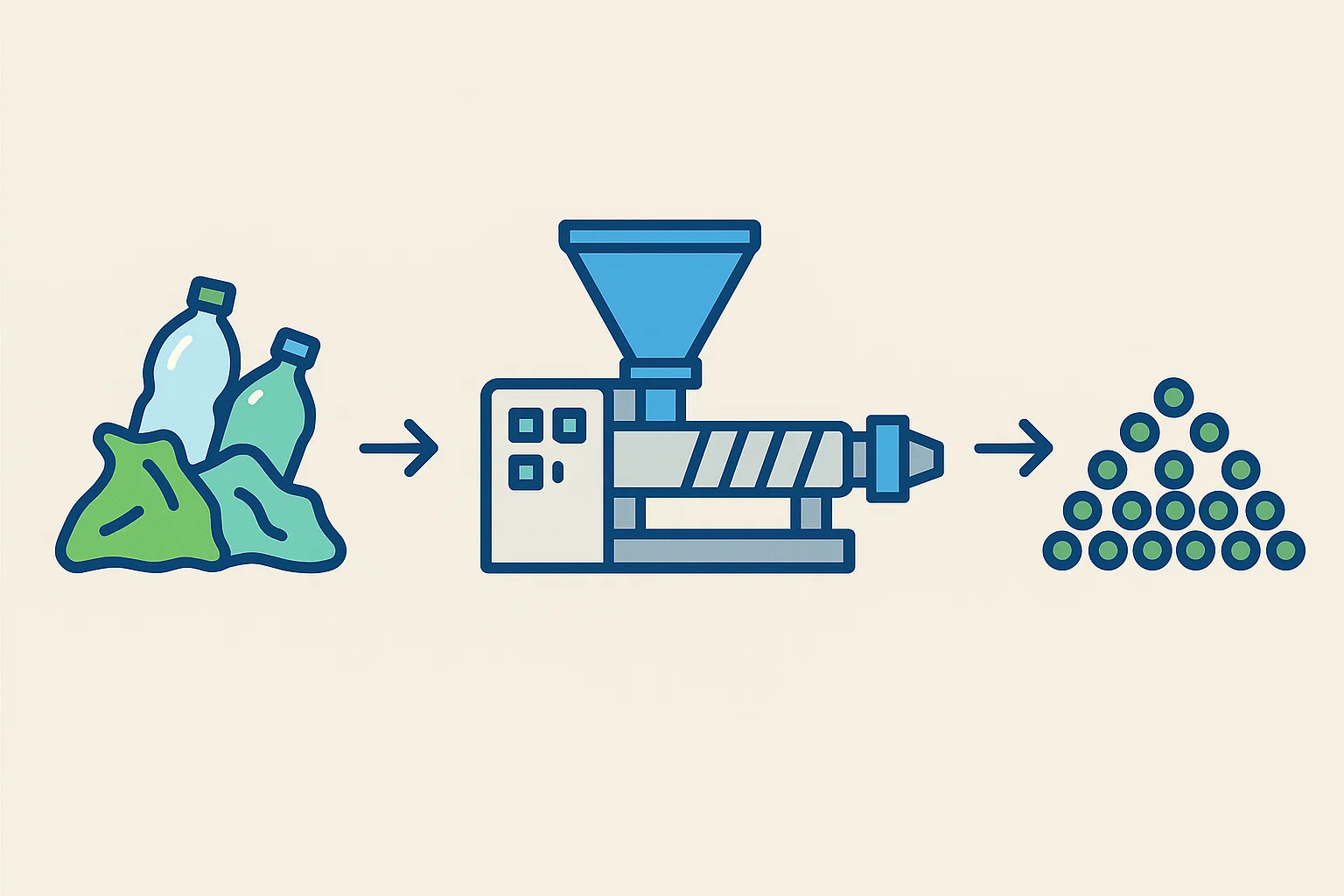
Choosing dewatering equipment for plastic film recycling is fundamentally a balance of thermodynamic efficiency, mechanical force, and moisture control. If washed film enters the pelletizing section with excessive surface or trapped water, extrusion throughput collapses, melt temperatures fluctuate erratically, barrel vacuum vents flood with water vapor, and pellet porosity spikes. The right drying strategy depends directly on polymer type, film thickness, contamination profile, target discharge moisture, and downstream extrusion configuration.
For industrial recycling facilities engineered by Rumtoo, dewatering is never treated as a single standalone machine. Instead, it is configured as a staged mechanical-thermal sequence integrated into an agricultural and stretch film washing line or an integrated washing and friction cleaning system.
Why moisture control is challenging for plastic film
Washed film flakes behave completely differently from rigid plastics (such as HDPE bottles or PP battery cases) inside dewatering machinery. Film presents four distinct physical obstacles:
- Massive Specific Surface Area: Film has an exceptionally high surface-area-to-weight ratio. A ton of 25-micron linear low-density polyethylene (LLDPE) film holds significantly more surface water film by weight than a ton of 3 mm HDPE flake.
- Capillary Trapping in Folds and Wrinkles: Flexible shredded film crumples and overlaps, trapping water inside tight interstitial pockets and folds that simple centrifugal airflow cannot penetrate.
- Low Bulk Density (Bulk Loft): Fluffy, uncompacted film flakes resist mechanical conveying and float within turbulent air streams, limiting centrifugal separation efficiency.
- Varying Thickness and Melt Flow: Ultra-thin agricultural mulch (< 15 microns) tears easily and clings together, whereas heavy post-industrial shrink wraps (100–150 microns) require high mechanical compression forces to expel liquid.
When residual moisture enters the extrusion extruder above acceptable thresholds, severe operational failures occur:
- Melt Degassing Overload: Vacuum vents become overwhelmed, causing volatile steam eruptions, vent surge, and polymer melt carry-over into vacuum pumps.
- Vapor Voids and Pellets Porosity: Unvented steam creates microscopic bubbles and hollow centers in finished pellets, ruining tensile strength and blow-film bubble stability.
- Extruder Barrel Wear and Corrosion: High steam pressure accelerates hydrolytic corrosion and abrasive wear on screw flights and barrel liners.
- Severe Output Losses: Vapor cushions reduce screw friction and convey rates, cutting overall extrusion output by 20% to 40%.
Technical Comparison of Film Dewatering Equipment
A reliable film washing plant deploys mechanical separation first to strip bulk free water, followed by compression dewatering, and finally supplemental thermal drying if necessary:
| Parameter | Centrifugal Spin Dryer | Mechanical Squeeze Dryer / Densifier | Hot-Air Thermal Cyclone Dryer |
|---|---|---|---|
| Primary Mechanism | High-speed centrifugal rotor & perforated screen basket | Progressive-pitch screw press with hydraulic choke / shear disc | Heated pneumatic transport pipe with cyclone separator |
| Inlet Moisture Level | 35% – 60% (direct from sink-float tank / wash basin) | 12% – 25% (post-centrifuge or post-rinse) | 5% – 12% (post-squeezer or post-centrifuge) |
| Discharge Moisture | 10% – 20% (film); < 3% (rigid flake) | 2% – 5% (semi-compacted pellets / chunks) | < 1.0% – 2.0% |
| Bulk Density Output | 40 – 70 kg/m³ (fluffy flakes) | 250 – 400 kg/m³ (dense popcorn / granules) | 50 – 80 kg/m³ (loose flakes) |
| Specific Energy Consumption | 12 – 22 kWh / metric ton | 35 – 55 kWh / metric ton | 80 – 140 kWh / metric ton (thermal + electrical) |
| Downstream Readiness | Unsuitable for direct extrusion; requires compactor | Directly feedable into film compacting pelletizing line or standard single-screw | Ideal for direct extrusion or storage silos |
| Key Maintenance Items | Screen basket wear, dynamic rotor blade re-balancing | Screw flight hardfacing re-tipping, ceramic wear rings | Heater element replacement, cyclone liner anti-wear |
Detailed Evaluation of Core Dewatering Technologies
1. Film Centrifugal Dryer (Spin Dryer)
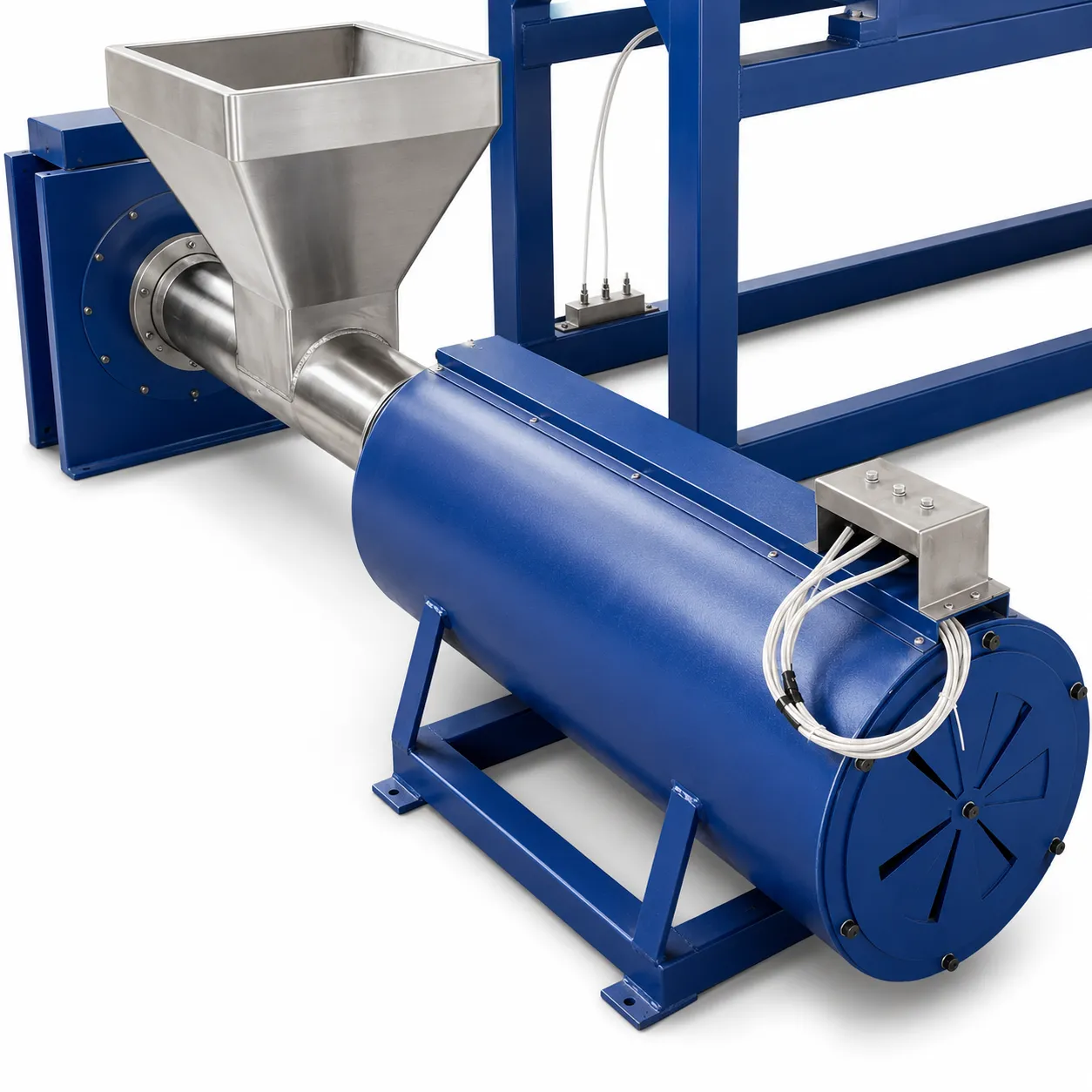
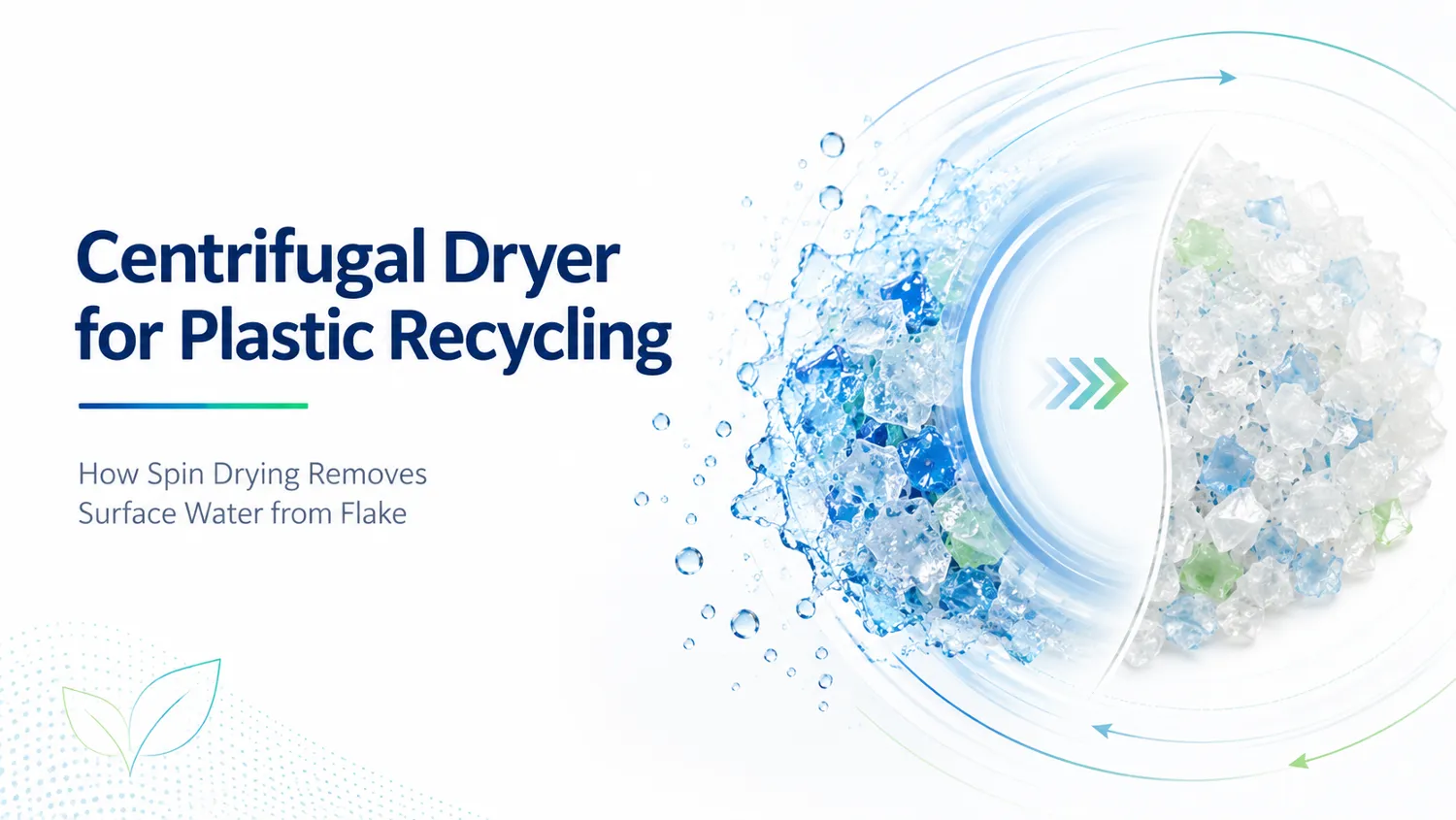
A dedicated film centrifugal dryer utilizes a high-rpm rotor (typically 800–1,200 RPM) equipped with angled, wear-resistant paddles inside a cylindrical perforated screen.
- How It Works: Slurry enters the bottom of the housing. Rotor paddles propel wet film flakes upwards along a spiral path while throwing water outward through perforated screens via centrifugal acceleration exceeding 400G.
- Best Applied For: Immediate primary dewatering directly after sink-float separation tanks or high-speed friction washers. It strips up to 85% of total liquid mass at low electrical consumption.
- Engineering Limitations: Because thin film layers fold over themselves, centrifugal force cannot expel water trapped inside creases. Consequently, centrifugal drying alone leaves film with 12%–20% residual moisture—far too wet for direct extrusion.
2. Squeeze Dryer / Mechanical Film Densifier
A high-pressure film densifier and squeezer represents the single most critical innovation in modern flexible plastic recycling.
- How It Works: A heavy-duty, hardened alloy screw with continuous reduction in pitch and flight depth compresses wet film inside a slotted barrel. At the discharge head, mechanical friction and hydraulic backpressure generate localized frictional heat (80°C–110°C). This action literally squeezes free liquid out through dewatering slots and flash-evaporates remaining surface water while densifying fluffy film into dense, semi-plasticized granules.
- Why It Transforms Production:
- Dramatically reduces moisture from 20%+ down to 2%–5%.
- Increases bulk density by up to 500% (from ~50 kg/m³ to 300+ kg/m³).
- Eliminates the need for massive thermal drying ducts and cuts electrical heating costs.
- Stabilizes feeding into single-screw and twin-screw extruders without bridging.
- Learn more about the underlying mechanics in our dedicated engineering overview on plastic film squeezer technology and our guide on densification in PP/PE recycling.
3. Thermal Pipe Dryer (Pneumatic Flash Dryer)
A thermal dryer relies on heated, high-velocity air streams inside insulated transport ductwork to vaporize boundary-layer moisture.
- How It Works: Clean hot air (heated via electric banks, steam coils, or gas burners) carries the film flakes through a vertical and horizontal labyrinth duct. Moisture evaporates during the 2-to-4 second flight time, and a high-efficiency cyclone separates dry flake from moist air.
- Best Applied For: Applications requiring strict final moisture tolerances (< 1.0%), or when processing thin agricultural film where mechanical squeezer shear must be minimized to avoid premature thermal degradation.
- Engineering Caveat: Evaporating water using thermal energy requires ~2,260 kJ per kg of water vaporized. Relying on hot air to remove bulk water that could have been mechanically squeezed is commercially unviable due to soaring utility costs.
Downstream Extruder Compatibility Matrix
Selecting your dewatering train depends heavily on the specific recycling pelletizing line operating downstream:
- Direct-Feed Extruder (Standard Single-Screw / Grooved Feed):
- Requirement: Strict moisture limit (< 1.5%), high bulk density (>280 kg/m³).
- Required Dewatering Train: Washing -> Centrifugal Dryer -> Squeezer Dryer -> Pelletizing.
- Integrated Cutter-Compactor Extruder:
- Requirement: Moisture tolerance up to 3%–5%, accepts lower density flake.
- Required Dewatering Train: Washing -> Centrifugal Dryer -> Squeezer OR Centrifugal Dryer -> Thermal Dryer. (The cutter-compactor drum provides additional frictional drying).
- Twin-Screw Degassing Extruder with Multi-Stage Vacuum:
- Requirement: Moisture limit up to 2.5% if twin high-vacuum degassing ports are installed.
- Required Dewatering Train: Washing -> Centrifugal Dryer -> Squeeze Densifier.
Feedstock-Specific Dewatering Recommendations
Clean Post-Industrial Stretch & Blown Film (BOPP, LLDPE)
- Low dirt contamination, consistent micron thickness.
- Recommended Train: Centrifugal dryer directly into a mechanical squeeze densifier. Thermal drying is usually unnecessary.
Post-Consumer Agricultural Mulch & Greenhouse Film (LDPE, EVA)
- High dirt loading, pesticide residues, extremely thin thickness (< 20 microns), retained moisture in folds.
- Recommended Train: Multi-stage washing -> High-speed centrifugal spin dryer -> Heavy-duty screw squeezer -> Secondary pneumatic hot-air flash dryer.
Woven Polypropylene (PP) Jumbo Bags / Raffia
- High tensile strength, water-retaining woven mesh structure.
- Recommended Train: High-torque shredder -> Friction washer -> High-efficiency centrifugal dryer -> Specialized high-torque squeezer with rotating cutter head.
4 Crucial Specifications to Demand From Equipment Vendors
When submitting an RFQ (Request for Quotation) to machine manufacturers, do not simply ask for nominal hourly capacity. Demand binding technical parameters:
- Guaranteed Output Moisture Guarantee: What is the measured moisture percentage (% wt) at the discharge chute for your specific film mix at full rated metric tons per hour?
- Specific Energy Metric (kWh/t): What is the combined motor and thermal power consumption per metric ton of processed dry film?
- Screen Openings and Metallurgy: What alloy is used for centrifugal screens (e.g., AISI 304 vs. hardened chrome wear plates) and what is the expected operating life under abrasive wash conditions?
- Bulk Density Verification: What is the post-dewatering bulk density (g/L or kg/m³) to ensure your extruder feed hopper will not bridge or starve?
Frequently Asked Questions
Can a centrifugal dryer alone achieve 2% moisture on LDPE film?
No. While a centrifugal spin dryer can achieve 1%–2% on rigid plastics (HDPE flakes, PET bottle flake), flexible LDPE/LLDPE film holds water trapped in folds and exhibits strong surface tension. Centrifugal drying alone typically bottoms out at 10%–15% moisture on washed film.
Does a film squeezer replace an agglomerator (pot densifier)?
Yes, in modern continuous automated lines. Batch agglomerators require manual labor, consume heavy electrical power, and introduce batch-to-batch variation. Continuous screw squeeze dryers run inline 24/7, delivering consistent moisture and density directly to the pelletizing extruder.
How does moisture affect recycled pellet melt flow index (MFI)?
While moisture does not chemically alter polyolefin chains as drastically as it degrades PET, severe moisture creates thermal cycling in the barrel, induces localized oxidation, causes unstable plasticization pressure, and ruins melt filtration efficiency.
Optimize Your Film Recycling Line with Rumtoo
Choosing the correct balance between centrifugal extraction, mechanical squeeze dewatering, and thermal finishing prevents costly bottlenecks and saves tens of thousands of kilowatt-hours annually.
Contact the Rumtoo Technical Team today for custom process audits, material test runs, and complete turnkey plastic film and bag recycling systems.
- dewatering equipment
- plastic film recycling
- centrifugal dryer
- squeeze dryer
- thermal dryer