
· Rumtoo Engineering Team · Buying Guides · 4 min read
PVC Pulverizer Guide: From Regrind to 20-120 Mesh Plastic Powder
Learn how to choose and operate a PVC pulverizer for your plastic recycling line. This guide covers rotor designs, cooling systems, and how to achieve consistent 20-120 mesh plastic powder from rigid PVC pipes and flexible scrap.
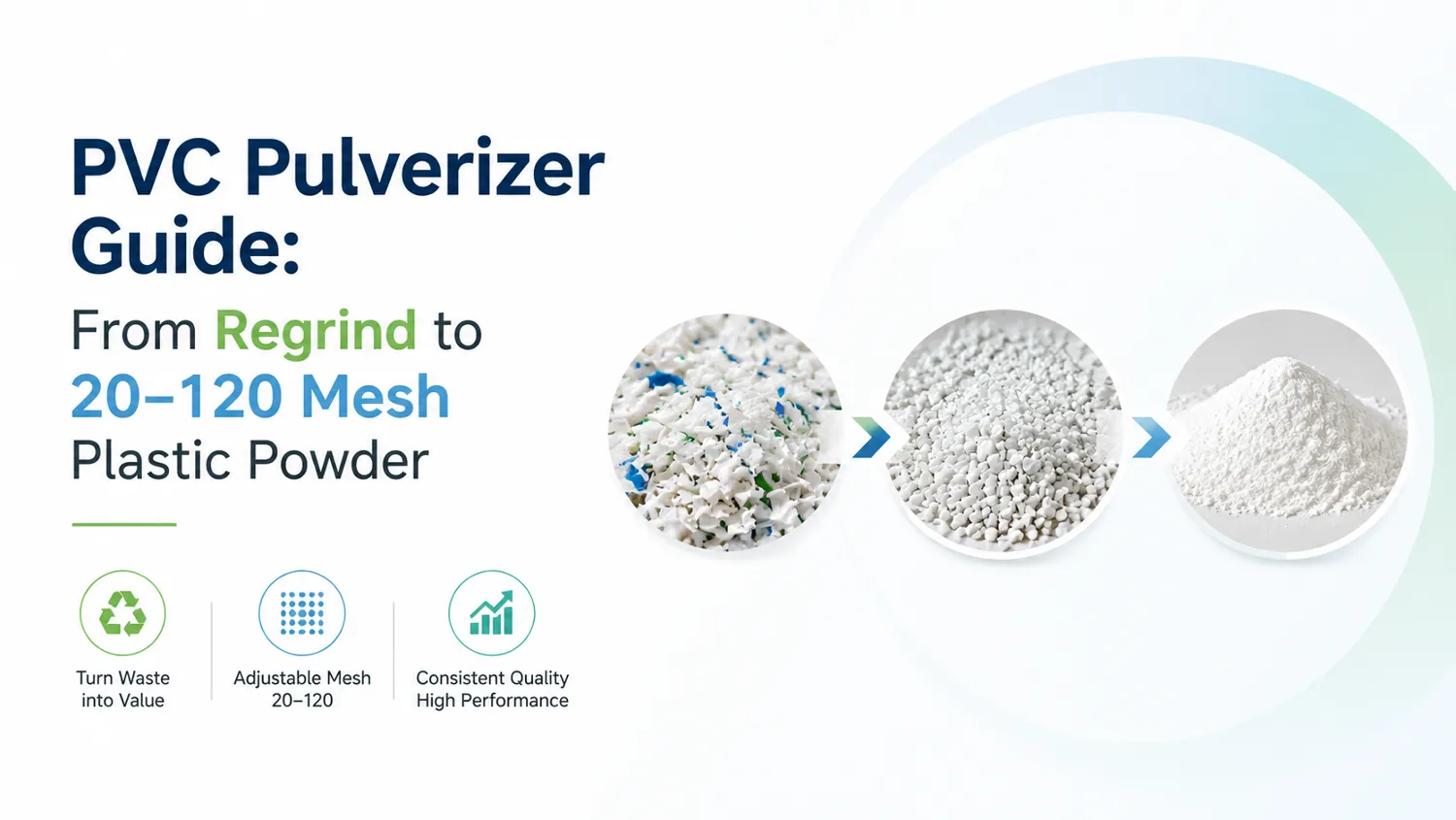
Converting PVC regrind into fine powder determines whether your recycled material can be profitably used in extrusion or injection molding. A plastic pulverizer machine solves the challenge of reducing rigid pipes, profiles, or flexible PVC into uniform 20-120 mesh powder without thermal degradation. This guide explains how to configure a PVC pulverizer to achieve maximum throughput while maintaining exact particle sizes.
What is a PVC Pulverizer?
A PVC pulverizer is a high-speed milling machine designed to reduce plastic flakes or regrind into fine powder. Unlike a shredder or granulator, which cuts material into coarse pieces, a pulverizer uses centrifugal force and precisely gapped grinding discs to sheer and grind plastic down to 20-120 mesh. This fine powder is essential for mixing with virgin resins in pipe, profile, and SPC flooring production.
Key Components of a Plastic Pulverizer Machine
Achieving consistent powder requires specific machine components to work in harmony. In our experience, the failure of any single component leads to caking, irregular particle sizes, or equipment damage.
High-Speed Grinding Discs
The grinding disc is the heart of the size reduction process. Material enters the center of the fixed disc and is pushed outward by the high-speed rotating disc. Operators adjust the gap between these discs to control whether the output is a coarse 20 mesh or a fine 120 mesh powder.
Wind and Water Cooling Systems
PVC is highly heat-sensitive. According to material processing standards, PVC degrades rapidly if subjected to prolonged heat during milling. Therefore, an industrial plastic pulverizer machine uses a combined wind and water cooling system. Water circulates through the stationary cutting chamber walls, while an integrated blower pulls air through the system. This simultaneously cools the material and conveys the powder to the cyclone separator.
Vibrating Sieve and Closed-Loop Return
A vibrating sieve guarantees that oversized particles do not enter your final product. The sieve filters the output, sending the correct 20-120 mesh powder to the bagging station while returning oversized flakes back to the grinding chamber for a second pass.
How to Choose the Right PVC Pulverizer for Your Plant
Selecting the correct machine requires analyzing your feedstock and production goals.
- Determine Your Required Fineness: Most pipe and profile extrusion processes require powder between 40 and 80 mesh. If you need finer powder (up to 120 mesh), you will need a pulverizer with higher motor power and a larger disc diameter.
- Calculate Target Throughput: Production capacities vary widely based on the motor. A 20kW motor might process 100 kg/h, while a heavy-duty 75kW+ motor can achieve up to 900 kg/h on rigid PVC.
- Assess Equipment Sizing: To match your exact throughput requirements with the correct motor size and disc diameter, review our range of high-performance pulverizers designed for rigid and flexible PVC.
Common Operational Challenges and Solutions
When testing PVC pulverizers in the field, operators frequently encounter two main issues that impact production efficiency.
Material Caking Inside the Chamber
Material caking occurs when the cooling system fails or the feed rate is too high. If the water jacket temperature exceeds safe limits, PVC softens and sticks to the grinding teeth. To prevent this, always monitor the cooling water flow rate and use an automated feeding system that adjusts based on the main motor’s amperage.
Rapid Blade Wear
Processing highly filled PVC (such as SPC flooring scrap containing calcium carbonate) accelerates blade wear. If you are milling abrasive materials, specify discs made from high-wear-resistant steel or tungsten carbide coatings to extend the maintenance interval.
Summary and Next Steps
A well-configured PVC pulverizer transforms low-value regrind into high-value 20-120 mesh powder, enabling closed-loop recycling in your manufacturing facility. By matching your motor power, cooling capacity, and grinding disc design to your specific material, you ensure consistent particle sizes and high throughput.
Ready to upgrade your plastic recycling line? Contact our engineering team to discuss your feedstock, or browse our complete selection of pulverizers to find the right plastic pulverizer machine for your operation.
- PVC pulverizer
- plastic pulverizer machine
- plastic powder milling
- plastic recycling machine